Process6 min read
What the Inspection Won’t Tell You About a Mid-Century Modern House
Buyers fall for the light; inspections report what can be seen. In a house with heating in the slab and drains under it, some of the costliest questions sit out of sight.
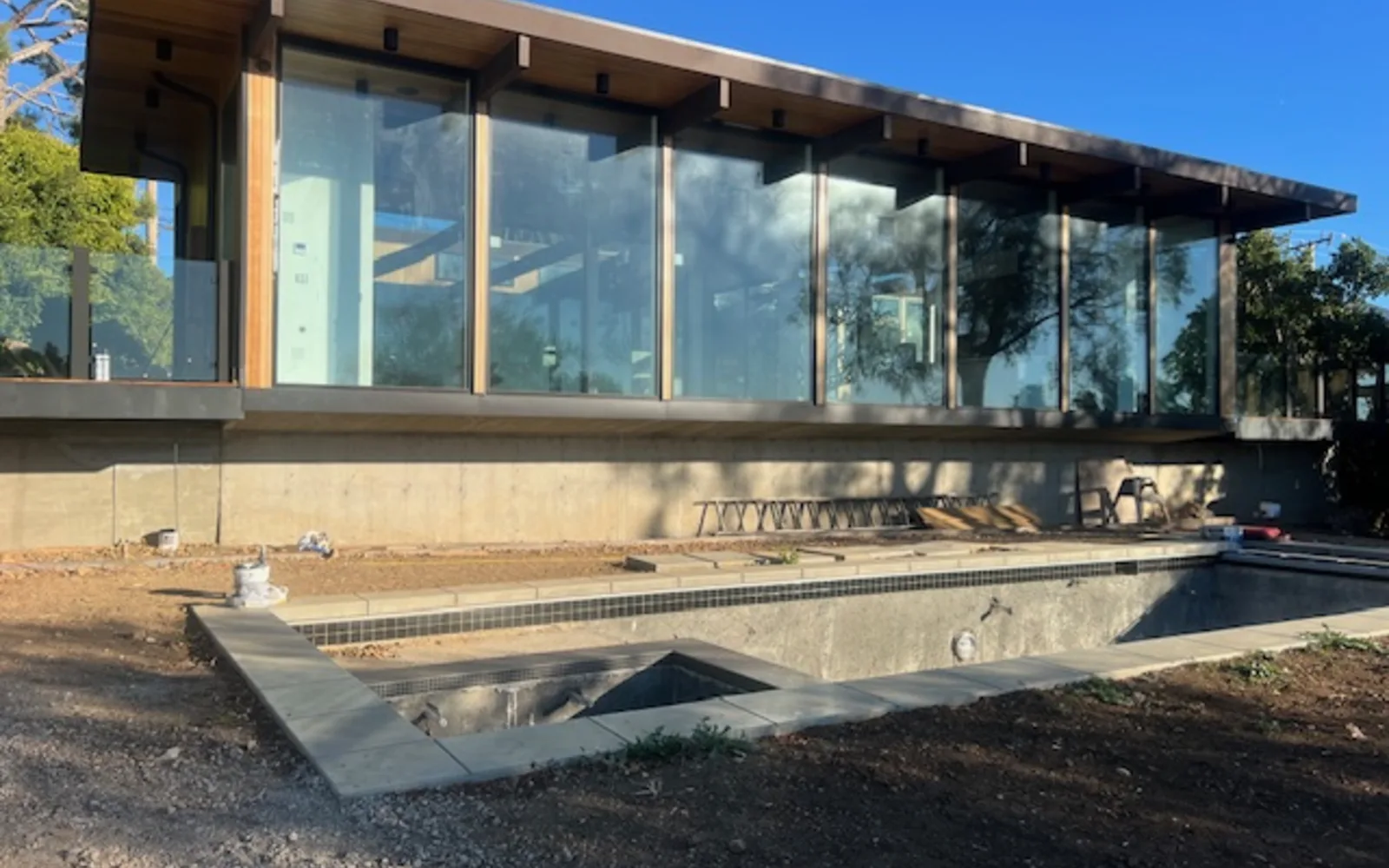
The listing photographs show a wall of glass and a ceiling of cedar. The inspection report shows a checklist. The house you are actually buying sits somewhere between the two, and a good part of it is under the floor.
Mid-Century Modern houses are bought on feeling: the way a ceiling runs outside through the glass, the way the room seems to have no edges. That is a legitimate reason to buy one. It is a poor reason to skip the questions these houses raise, because the people who built them were working with new systems and new materials, and some of those have aged in ways a standard walkthrough was never designed to catch.
An inspection reports what it can see
A home inspection is a limited document by design. The American Society of Home Inspectors’ Standards of Practice, section 2.2.A, tells the inspector to “inspect readily accessible, visually observable, installed systems and components listed in this Standard.” The same document lists what falls outside: concealed conditions and latent defects (13.1.B.2.a), the condition of systems and components that are not readily accessible (13.2.A.1), and underground items (13.2.E.1).
That works for a conventional house with an attic, a crawlspace and a furnace closet. It works less well when the heating is cast into the slab, the drains run under it, and the structure is a frame whose weak points sit at the ends of beams, well above the reach of a flashlight. The inspection clears the visible house. Many Mid-Century Modern risks live in the concealed one.
The floor that heats the house
Eichler Network, which writes about the houses of Eichler Homes, tells the story of the radiant heating cast into their slabs. According to its account, copper pipe was used from 1950, steel from late 1951 because of a copper shortage during the Korean War, and copper again from the late 1950s. The result, it says, was “several thousand steel systems with uncertain futures” and “a trail of corrosion and litigation.” That account is about Eichler Homes. It should not be read as a rule for every house of the period.
Whether a particular system is steel or copper has a cheap first test. The article’s suggestion is a magnet: if it sticks to the manifold, the fitting that distributes hot water from the boiler, “you’ll know it’s steel.” The warning signs it lists are ones a buyer can ask about: higher water bills, a hot spot on the floor, puddles and mildew under carpets, the sound of running water, and white powdery residue at the base of the foundation. For a steel system, it says, a first leak “could forecast the eventual end of your system’s useful life.”
A visual inspection cannot see pipe in concrete. Asking whether the slab has ever been pressure-tested, and what the answer was, is a buyer’s question as much as an inspector’s. A house can look flawless and be heating itself through a pipe with a finite life.
Wires, and what the house was made of
Original wiring is the next question, and here the dates help if you read them carefully. The US Consumer Product Safety Commission’s publication on aluminum wiring reports that builders increased their use of aluminum branch-circuit wire after a copper shortage in the mid 1960s, that homes built before 1965 are unlikely to have it, and that cable made between 1965 and the mid 1970s may contain it. The commission’s survey found that homes built before 1972 and wired with aluminum were 55 times more likely than copper-wired homes to have outlet connections reach “Fire Hazard Conditions.” The survey looked only at outlet connections, and the commission notes that failing connections seldom give warning signs.
A house built in 1956 predates that surge. A 1970s remodel or addition to it may not. The age on the deed is therefore less informative than the age of each wire, which is a question for an electrician with the panel cover off.
Then the materials. The US Environmental Protection Agency says you cannot tell by looking whether a material contains asbestos unless it is labeled, that undamaged material left undisturbed should be left alone, and that testing is unnecessary if the material will not be disturbed. It adds that a professional may be wanted for remodeling or when the material is damaged. For a buyer planning work, that is the cue: ask what is in the house before anything is cut, not after.
Drains and the line to the street
The ASHI standard’s exclusion of underground items names underground storage tanks as one example, and it covers whatever else lies below grade. A camera in the sewer line to the street is therefore not something to assume a baseline inspection has done. Ask whether it has been done, and if not, arrange it on its own before the contingency period ends.
Rot starts at the top; the paperwork starts earlier
Post-and-beam houses show their age at the ends of the beams. Adam Ramirez of RETRObeam Restorations tells Eichler Network: “Usually the damage starts at the very top, at the connection to the fascia tile above the beam.” The signs the article lists are crumbling or warped beam ends, wood pushing downward, and bulging undersides, and its practical advice is to poke the wood with a sharp tool. A buyer’s contractor can do so with the seller’s permission.
The other thing a walkthrough cannot see is what was never permitted. A page on unpermitted work by the law firm Bay Legal PC summarizes the California rules that matter to a buyer. The disclosure statement required by Civil Code section 1102.1(a) cannot be waived by selling a house “as is.” And under Health and Safety Code section 17980, once an owner has had 30 days’ notice, the enforcing agency can begin abatement of substandard work by repair, rehabilitation, vacation or demolition. A glass-walled house is an obvious candidate for the enclosed patio, the added bedroom, the converted carport.
The way to find it is dull and effective: pull the permit history from the city or county before the offer, and compare it to the plan on the ground.
A first reading, before the first offer
Philippe Naouri Studio, a Malibu studio restoring Mid-Century Modern houses, begins its work with a reading rather than a drawing. Its first milestone is called “Read the property,” and it begins with a plain statement: “Before we draw, we understand.” The list that follows runs “Land. Orientation. Approach. Privacy. Existing architecture. Provenance. Constraints. Views. Opportunity.” The deliverable is described as a concise diagnosis of what exists and what the property wants to become.
That is not a home inspection and does not replace one. It is the question that comes before it: whether this house, with this structure, on this land, is the one to commission work on. The studio’s Maison Study is described in similar terms, as fast enough to influence a decision and deep enough to prevent the wrong one.
What to ask, in order
Before the offer: the permit history, the slab heating type, the age and material of the wiring. During the contingency period: a camera in the sewer line, an asbestos sample if any renovation is planned, a close look at the beam ends. Then ask how the seller learned what the seller knows.
The light is real. So is the pipe under it.
Sources
- ASHI Standard of Practice (2014) (opens in a new tab), American Society of Home Inspectors (copy hosted by Home Inspection Services)
- ASHI SoP - 2015 (opens in a new tab), Mississippi Home Inspector Division
- Joint of No Return (opens in a new tab), Eichler Network (Adriene Biondo)
- Galvanized vs. Copper Radiant Heating in Eichler Homes (opens in a new tab), eichlerforsale.com
- Repairing Aluminum Wiring (Pub 516) (opens in a new tab), US Consumer Product Safety Commission
- Aluminum wiring (CPSC document AL) (opens in a new tab), US Consumer Product Safety Commission
- The problem of aging electrical wiring (Jim Lardear) (opens in a new tab), PowerCheck
- Aluminum Wiring safety guide (opens in a new tab), Red River Mutual
- Protect Your Family from Exposures to Asbestos (opens in a new tab), US EPA
- 'Beaming Up' for a New Year (opens in a new tab), Eichler Network (Dan Smith)
- Unpermitted Work California Home Purchases: Risks, Fixes, and Liability (opens in a new tab), Bay Legal PC
- California Civil Code § 1102.1 (opens in a new tab), FindLaw
- California Health and Safety Code § 17980 (opens in a new tab), FindLaw