Provenance5 min read
Original Is a Moving Target: What a Mid-Century Modern House Goes Back To
Houses change while their owners are living in them. Preservation standards give four ways to respond, and choosing one means deciding which year counts.

Ask what a house looked like when it was new, and you have already made a choice. You have picked a moment and called it the original.
For a Mid-Century Modern house, that moment is shorter than it sounds. Houses of the postwar era were lived in, and living changes a house. By the time a house reaches a restorer, there is rarely a single original. There are layers.
Four verbs
The National Park Service sorts the options into four treatments, and the vocabulary is worth knowing because the words are used loosely. Preservation keeps a historic property as it is, maintaining its existing integrity and character. Rehabilitation allows alterations and additions that make a compatible contemporary use possible. Restoration returns the property to its appearance at a specific period of its history. Reconstruction recreates what has been lost.
The difference between rehabilitation and restoration is the whole argument. Rehabilitation lets a house keep living, and asks that changes be compatible. Restoration asks the house to stop at one date and remove what came after.
What the Standards ask
The Secretary of the Interior’s Standards for Rehabilitation are the ones most owners meet, because they are the ten rules attached to federal preservation tax incentives. Several of them speak directly to the problem of the moving target.
Standard 3 says each property is to be recognized as a physical record of its time, place and use, and forbids changes that create a false sense of history, such as conjectural features. Standard 4 says that most properties change over time, and that changes which have acquired significance in their own right are to be retained. Standard 6 says deteriorated historic features are to be repaired rather than replaced. Standard 9 says new work is to be differentiated from the old and compatible with it.
Read together, the Standards allow a house to carry its history, including later changes, and ask that the history be honest. That is a more generous idea of original than the day it opened.
Casa Kuderna: the archive decides
Casa Kuderna, in Los Angeles, shows the problem plainly. Craig Ellwood designed it in 1956, with James Tyler, for the corporate illustrator Charles Kuderna. When the house came to market in 2018, later overhangs and sun screens had been added to Ellwood’s frame. The additions were not part of the drawing. They were part of the house.
The studio’s version of the story is a restoration in the strict sense. Philippe Naouri bought the house that year and restored it from the archives of James Tyler, with the archivist Barton Jahncke. The additions came off. The yellow exterior spiral stairs, the windows and the woodwork were restored. The floor-to-ceiling jalousie windows, the brick-and-steel fireplace and the walls of glass are original and stayed.
Notice what did the deciding. It was not the house as found, which carried the later layers. It was the architect’s own documents. When the Standards warn against conjectural features, an archive is the opposite of conjecture: it is evidence.
That is also a limit. An archive tells you what was drawn. It does not always tell you what was built, or what the first owner changed in the first year. The purist’s original is a document. The living house is something slightly different.
Rising Glen: nearly seventy years, untouched
Rising Glen runs the other way. Richard Frazer built the house on Rising Glen Place in the Bird Streets in 1956, for the producer Stanley Rubin and the actress Kathleen Hughes. When it came to market, after nearly seventy years in the family that built it, it was still the original, untouched.
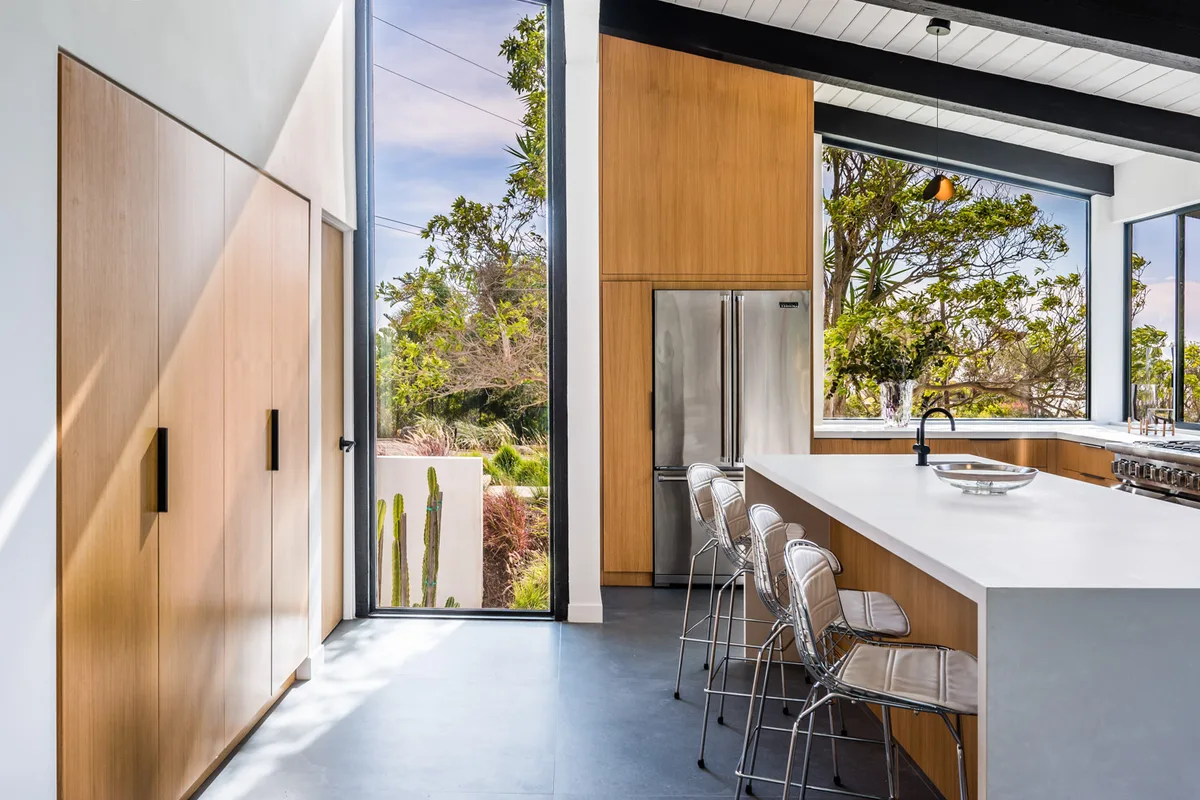
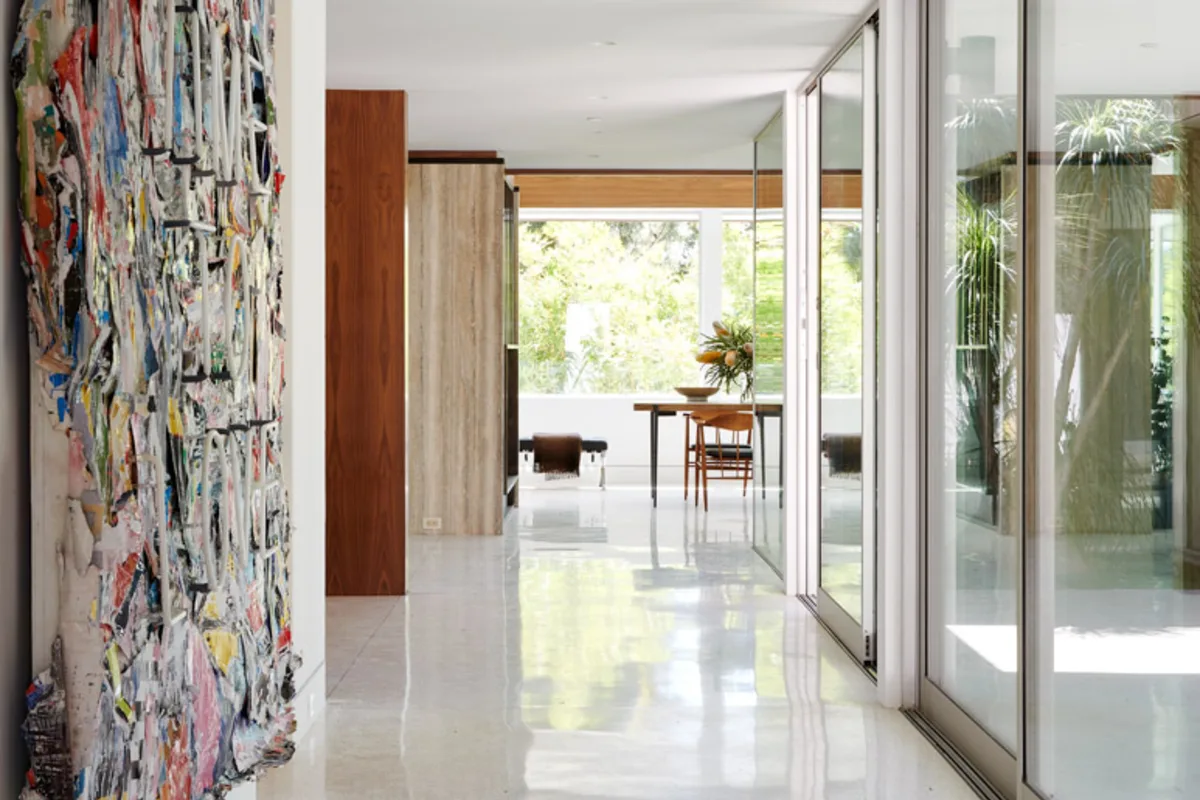
A house like that is rare, and it is the kind of record preservationists want kept. It is also a house that, after nearly seventy years, needed what that much use asks for. In the studio’s account the house was rebuilt to the studs. Terrazzo went in throughout, along with a new kitchen, a glass-lined primary suite and a new freeform pool and spa, and a desert garden of cactus and boulders replaced the lawn.
Is that a betrayal of the untouched original, or the reason the house survives to be lived in? The Standards would call it rehabilitation, with a requirement that new work be compatible and distinguishable. Whether Rising Glen meets that test is a judgment for a viewer standing in the entry court, not a rule.
Filaree Heights: the line you keep
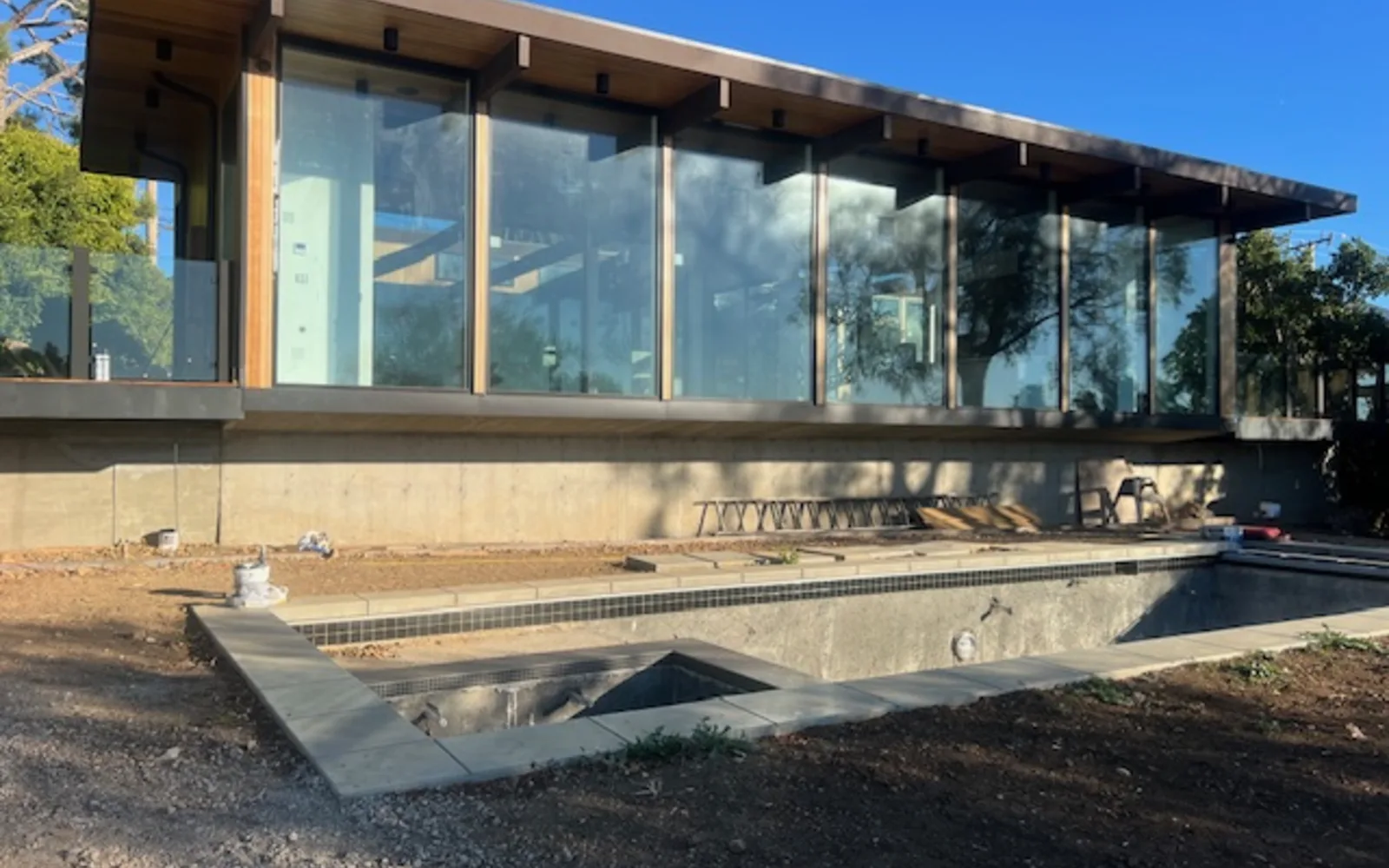
At Filaree Heights in Malibu, the Edward Fickett house is a long, low pavilion under exposed black beams, with glass on every garden side, the structure doing the talking. The studio’s work put warmth around that argument: white walls and dark beams inside, slatted wood in the hall and the bedrooms, a stone fireplace sunk into the living room, ipe decks running out to the lawn.
Here the question of the moving target answers itself. What is worth keeping is not a date. It is a rule: the structure stays visible, and the warmth is added around it.
Purity and life
Purity has an argument. A house restored to one moment is a rare thing, a time capsule a visitor can read. Living history has an argument too: a house that cannot be changed becomes a museum, and a museum house is often an empty one.
The park service’s own answer is a spectrum, not a verdict. Preservation, rehabilitation, restoration and reconstruction are not rungs of virtue. They are different promises. The honest question for any Mid-Century Modern house is which promise the owner is making, and who gets to check that it was kept.
Seen that way, the studio’s three houses are three promises. Casa Kuderna promises a date and keeps it with an archive. Rising Glen promises a house that continues. Filaree Heights promises a line. None of them is the original. Each is a decision about what the original meant.
A house with a record
The studio describes a residence archive that collects a project’s drawings, materials, suppliers, provenance, warranties and project records into one permanent record. It calls the result a house with a record, and says the house leaves the studio with its memory intact. That is the quiet answer to the moving target: if you cannot freeze a house, write down what it was.
Sources
- Treatment of Historic Properties (opens in a new tab), National Park Service
- Secretary of the Interior's Standards for Rehabilitation (opens in a new tab), National Park Service