Collected interiors6 min read
The Wall That Held the Furniture: How Mid-Century Modern Houses Absorbed Their Contents
In the best Mid-Century Modern houses, the chair and the wall were designed as one thought. The showroom interior, assembled afterward from a catalogue, undoes that thought piece by piece.
Walk into a good Mid-Century Modern house and try to say where the architecture stops and the furniture starts. In the Eames House it is hard to do cleanly. The panels, the collected objects and the chairs belong to one composition.
That is the quiet claim of the period, and it is easy to miss now that a Mid-Century Modern chair is something you can order online. The designers whose names fill the catalogues, Eames, Nelson, Saarinen, were working inside a larger idea: that a house and what it holds should be planned together.
The house that was also a collection
Charles and Ray Eames designed their own house in Pacific Palisades as Case Study House No. 8, part of the program Arts & Architecture magazine announced in its January 1945 issue. Construction began in February 1949. The Eames Foundation says the foundation and steel frame were complete after 16 hours, and the couple moved in on Christmas Eve that year. It is a residence and a separate studio set into the hillside, with a 17-foot-tall facade built as a steel grid and filled with panels of different materials and colors, some transparent and some solid.
What makes it instructive for this subject is what is inside. The living room fills the double-height southern end of the residence. By the late 1950s, the National Park Service's landmark nomination records, the house held a sizable collection of furniture, much of it of the Eameses' own design, along with rugs, blankets, lanterns, statuary, plants, toys, dolls, pillows, candlesticks and masks. The collection is a major part of the interior, not a layer added to it.
The house is now a National Historic Landmark, designated on September 20, 2006, and Los Angeles Historic-Cultural Monument No. 381, designated in July 1988. The Eames Foundation says the interior, its objects and its collections remain very much the way they were in Charles and Ray’s lifetimes.
The wall as furniture
George Nelson put the same idea in a different register. His storage wall, a recessed, built-in unit of shelving that holds a household’s belongings as part of the room, drew wide public attention in Life magazine in 1945, the year he published Tomorrow’s House, written with Henry Wright (Simon and Schuster).
The idea was that the contents of a house could stop being freestanding objects pushed against a surface and become part of the surface. A room planned that way has fewer pieces standing in it, and each remaining piece has a reason to be where it is. Nelson later became director of design at Herman Miller, from 1947, and the company’s catalogue turned his thinking into products. The built-in and the piece of furniture began as two ends of one problem.
The catalogue also did something the wall did not. A chair in a catalogue can go anywhere. A storage wall can only go where it was built.
That difference is the whole subject. Portability made good design available to people who could never commission a house, and that is a real achievement. It also separated the object from the reasoning that produced it. The chair arrived in the living room without the plan that explained why it belonged there, and over the decades the plan was forgotten while the chair was reproduced.
The tension: composed or collected
This is where the argument sits. A designed object gains its authority from the room it was drawn for. Once it is reproduced, shipped and bought for its name, the room is no longer drawing it in. The result is a familiar interior: an Eames chair, a Nelson clock, a Saarinen table, arranged in a room that could belong to anyone. Every piece is correct and the room is not about anything.
The Eames House shows the alternative. Its objects are there because two people lived among them. Nobody can reproduce that by ordering the same chairs.
The honest difficulty is that the market rewards the showroom version. Catalogue pieces are available, legible and photograph well. A composed interior takes longer, costs attention and cannot be bought in a single transaction. Whether a house with a few perfect objects is better than a house with an interesting argument is not a question the furniture itself can answer.
What a collected room asks of its owner
If furniture is part of the architecture, then three things follow for anyone filling a Mid-Century Modern house.
The plan decides first. In a house built on a regular bay or module, the module tells you where large pieces can live. A sofa that fights the bay will look wrong whatever it cost.
Authorship matters more than name. A piece with a known maker, date and history is a different kind of object from a reproduction, and the difference shows over years, not on the first day.
Provenance is a record, not a story. Where a piece came from, what has been restored and what has been lost are facts that belong written down.
None of this is new. It is what the Eameses did with their own collection.
There is also a practical test, and it costs nothing. Stand in a doorway and remove, in imagination, every object in the room that could be replaced by an equivalent from a catalogue. What remains is the composition. If nothing remains, the room is a list. If something does, such as a wall of shelves that only fits one bay, a table that anchors the plan or a collection that has grown over decades, that is the part to protect when a house is sold, restored or refurnished.
The same test applies to owners who inherit a house with its contents. The temptation is to clear the rooms and start again from a clean inventory. The better first step is to photograph the rooms as they are, record where each significant piece stands and why, and only then decide what leaves.
How the studio approaches it
Philippe Naouri Studio treats the interior as its own service, called The Interior, and states its position in the headline: “Collected, not decorated.” The studio says it does not begin with a furniture list. It begins with the architecture, the client and what is already worth keeping.
Its method runs in eight steps. The first is to read the house, on the principle the studio states as “architecture before furniture.” Next comes editing what exists: the client’s collection is photographed, catalogued and assessed piece by piece, each marked to keep, restore, move, store, sell or add. A collection map then sets out anchor pieces, around which rooms are composed, quieter supporting pieces, art and objects, and custom work where the architecture demands something unique. After the search, every significant acquisition is verified for authorship, date and edition, provenance, condition, restoration history, dimensions and price. The last steps are restoring, installing and recording each important piece in what the studio calls the Collection Ledger.
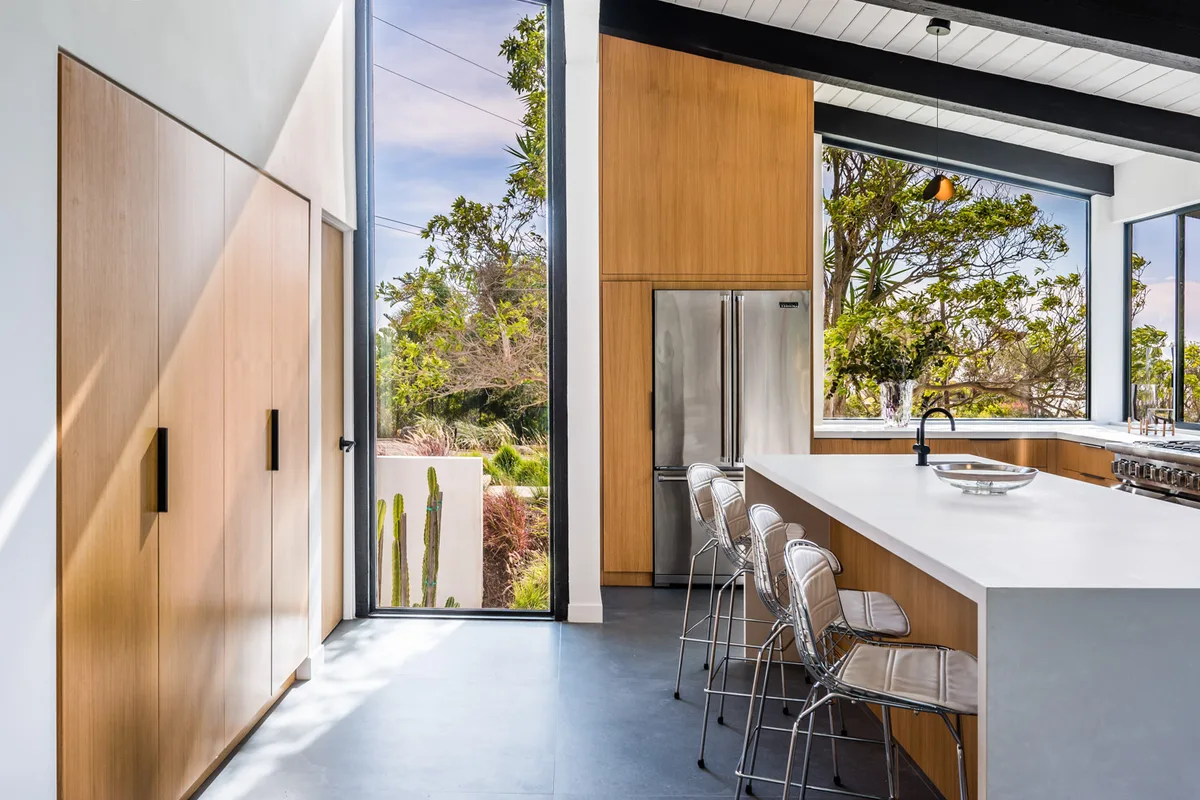
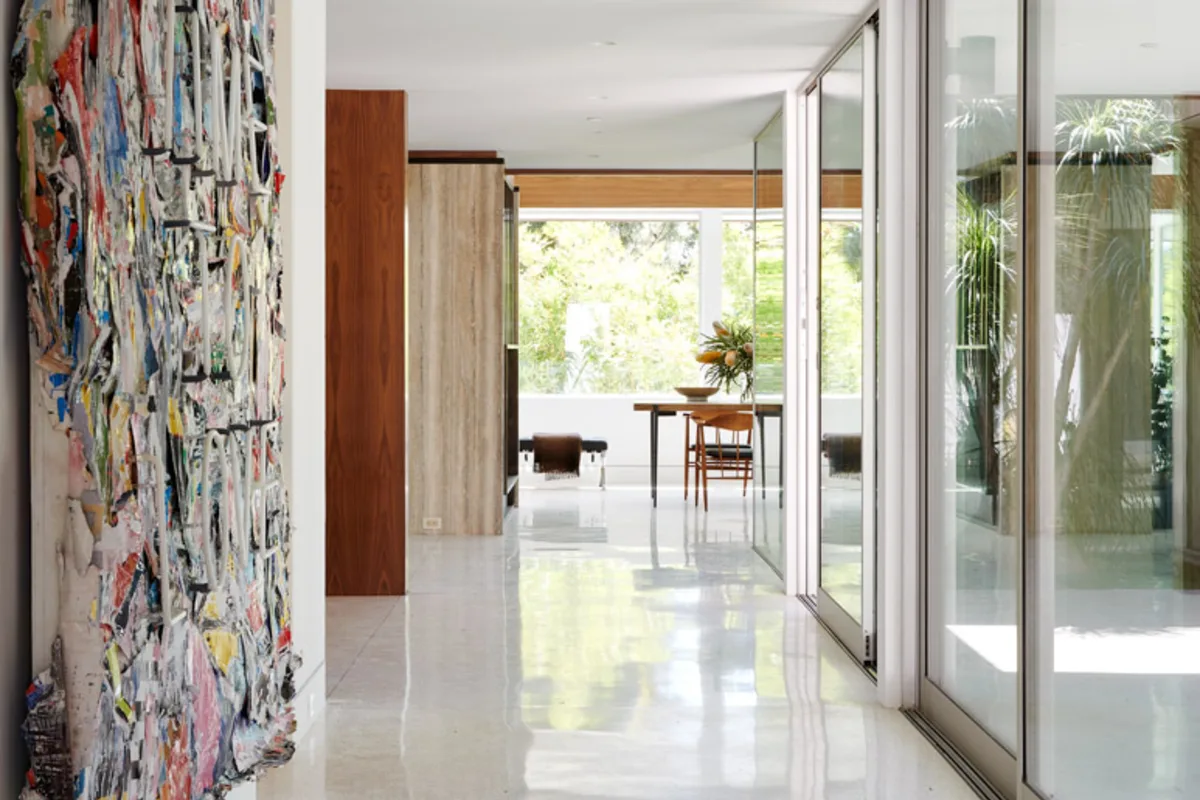
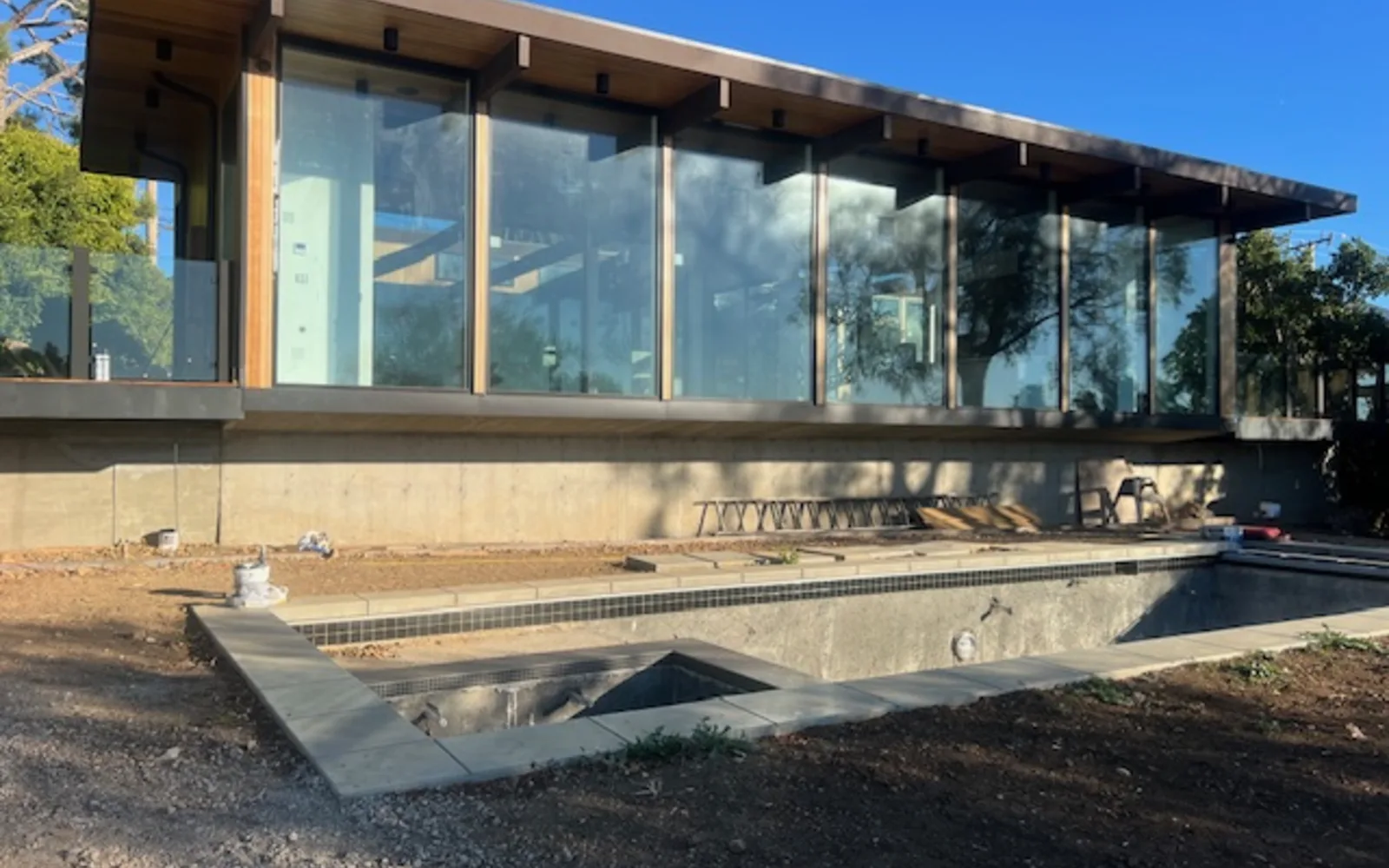
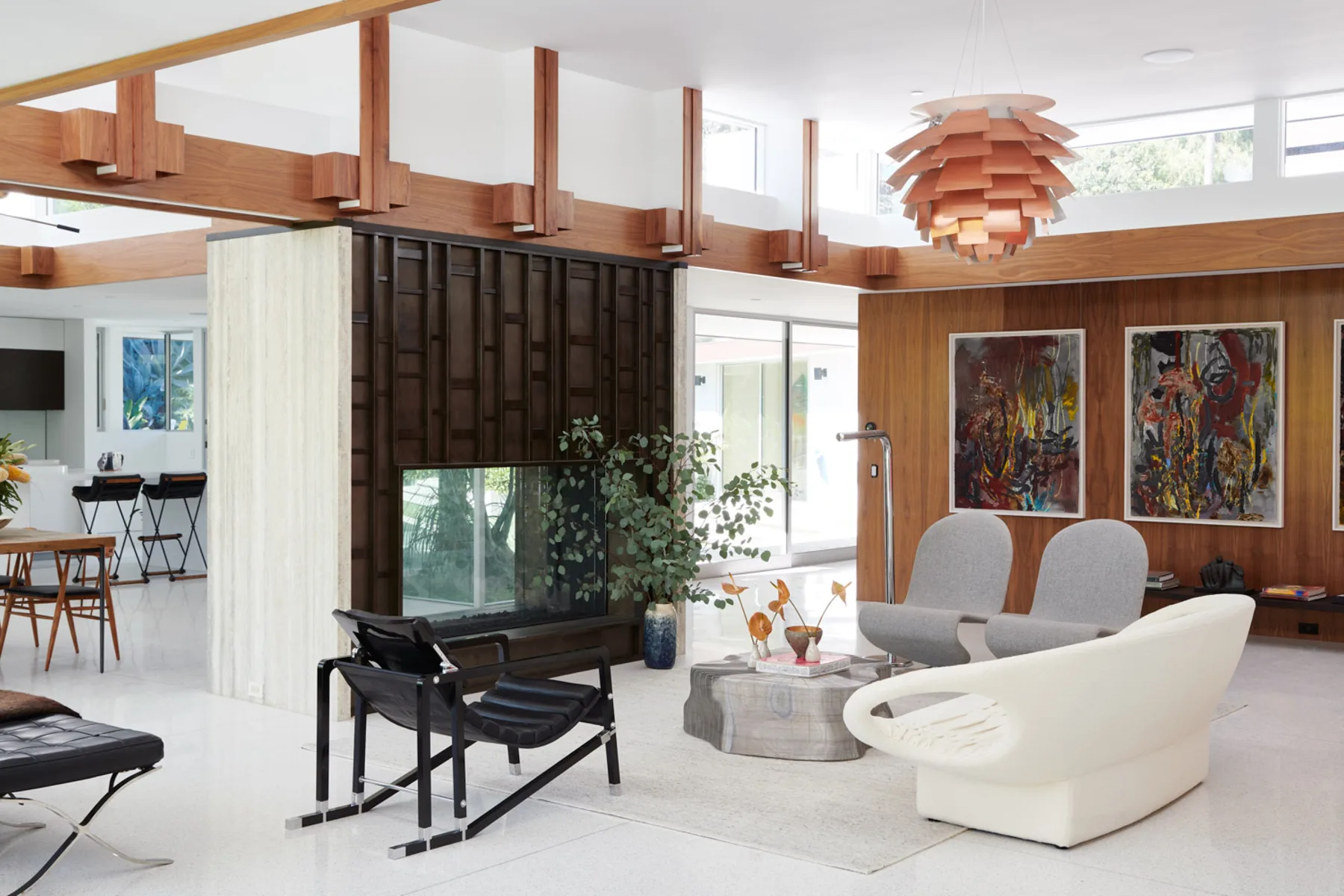
The studio’s house at 20737 Cool Oak Way in Malibu, a canyon property among oaks above the Pacific, shows the same pairing of frame and contents in its own photographs: dark timber and glass outside, white rooms and pale oak inside, bronze entry doors, terrazzo and a cedar sauna. Its gallery captions describe a dining room with a black table, a grand piano and the ocean through the glass, and a living room with black leather chairs, a bright rug and the canyon in the glass. The studio lists the project as completed.
Sources
- Eames House National Historic Landmark nomination (opens in a new tab), National Park Service
- Eames House (NRIS 06000978) (opens in a new tab), National Park Service NPGallery
- Arts & Architecture: Introduction (opens in a new tab), Arts & Architecture
- Case Study House #8 (opens in a new tab), Eames Foundation
- Eames House (opens in a new tab), Los Angeles Conservancy
- Discover the landmark houses of Los Angeles (opens in a new tab), Discover Los Angeles
- Tomorrow's House (opens in a new tab), Internet Archive
- George Nelson's visionary design (opens in a new tab), The Henry Ford
- George Nelson (opens in a new tab), Herman Miller