Provenance5 min read
Googie Coffee Shops in Los Angeles and How the Style Got Its Name
A coffee shop on the Sunset Strip gave a style its name in 1952. A few of the Los Angeles diners built in its spirit, from Norms to Johnie’s to a Downey hamburger stand, were saved.
In February 1952, House & Home magazine gave several pages to something it called “Googie Architecture.” The contents page promised “Googie Architecture-Los Angeles does its bit.”
The name came from a coffee shop, and that coffee shop is gone. A few of the buildings that grew up around the word are not. This is how the style was named, what shaped it, and how some of its Los Angeles coffee shops, and one hamburger stand, were kept.
A name from a coffee shop
Googie’s stood on the Sunset Strip. John Lautner designed it in 1949, and the Los Angeles Conservancy notes that the building has since been demolished.
SAH Archipedia credits the architecture critic Douglas Haskell with christening the style in a 1952 issue. The piece is not a sober survey. It is written as a conversation in which a character named Professor Thrugg explains the new fashion to a student.
The professor describes the original. It “starts off on the level like any other building. But suddenly it breaks for the sky.” Its bright red roof of cellular steel decking “tilts upward as if swung on a hinge, and the whole building goes up with it like a rocket ramp.”
Googie, the professor says, adds “all of Popular Mechanics” to the inventions of the modern engineer: “doors that disappear into the ground, overhead lights that cook the hamburger.” Because another building stands next door, the flight stops as suddenly as it began, and he sighs that it seems to symbolize life today: “skyward aspiration blocked by Schwab’s Pharmacy.”
Built for the car
Southern California was filling up. SAH Archipedia notes that migrating workers flocked to the state, “more than doubling the population of Los Angeles between 1940 and 1960.” A network of freeways, funded by the 1947 Collier-Burns Highway Act, “facilitated transport around this decentralized metropolis.”
The Conservancy places the California coffee shop in the same window: “From 1945 to 1965, the California coffee shop, a new restaurant type and architectural style, developed in Southern California in response to the return of prosperity after World War II, rapid population growth, and the rise of the suburbs.”
SAH Archipedia lists the hallmarks of the style: “Sweeping canopies, folded eaves, and tapering pylons,” alongside “towering neon signage that was typically decorated with boomerang or starburst motifs.” Among the architects it names as known for exuberant Googie structures are Douglas Honnold, Armet and Davis, and Powers, Daly and DeRosa.
Armet and Davis did the most to spread it. Louis Armet and Eldon Davis established their firm in 1947. The Conservancy credits them with the construction of over 4,000 Googie restaurants, including prototypes for chains such as Denny’s and Bob’s Big Boy. Architectural historian Alan Hess, in his book Googie: Fifties Coffee Shop Architecture, wrote that the firm “established Coffee Shop Modern as a major popular modern style.”
Davis himself was plain about the purpose. In a remark the Conservancy quotes, he said: “We would have liked to have made them more aesthetic, but we were just designing them to sell hamburgers.”
Norms on La Cienega
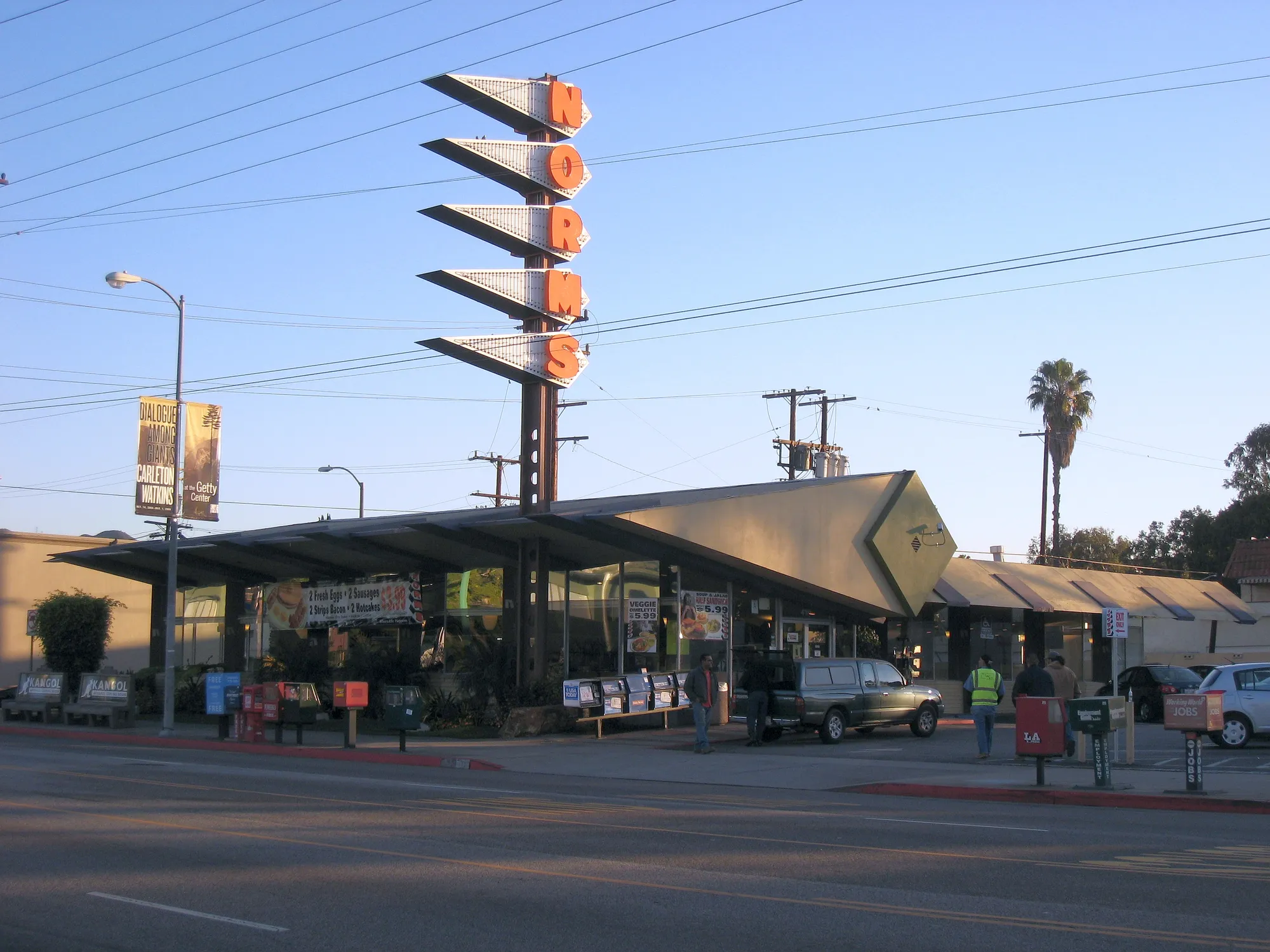
Norm Roybark, a Los Angeles native, opened the first Norms restaurant in 1949 and moved on to the La Cienega Boulevard location in 1957. Armet & Davis and Helen Fong are credited as the architects of that building. The Conservancy calls it “among the most exuberant and exaggerated Googie designs in the nation.”
The architects gave it a monumental “saw tooth pennant” neon sign spelling out N-O-R-M-S, there to capture the attention of drivers and would-be diners. The sign echoed the building’s diamond-shaped roofline, and the same geometry was repeated through the interior.
In December 2014, the Conservancy and its Modern Committee nominated Norms La Cienega for designation as a local landmark. On May 20, 2015, the Los Angeles City Council voted unanimously to designate it a Historic-Cultural Monument. The Conservancy counts approximately eight Googie coffee shop restaurants remaining in the city today.
Johnie’s and Pann’s
Johnie’s, at Wilshire Boulevard and Fairfax Avenue, was built in 1956 as Romeo’s Times Square. It later became Ram’s, and then Johnie’s in 1966. The business operated continuously until 2000. The Conservancy says the building was designed by Louis Armet and Eldon Davis.
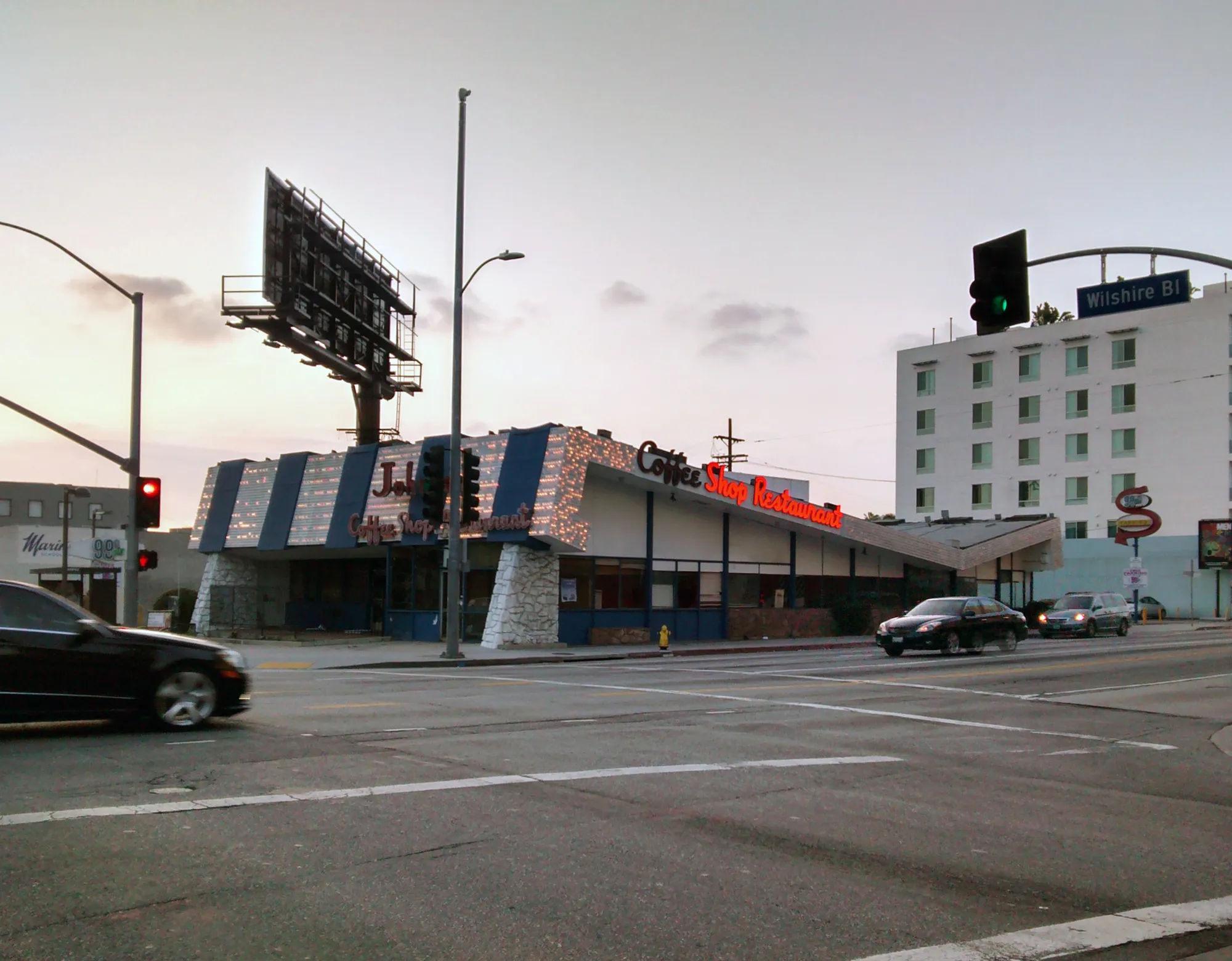
Plans for a new Metro station at Wilshire and Fairfax prompted concern about the building’s future. The Conservancy nominated Johnie’s as a Historic-Cultural Monument, and the City Council approved the designation in November 2013.
Pann’s, on La Tijera Boulevard, dates from 1958 and is also credited to Armet & Davis and Helen Fong. The Conservancy describes an “immense, hovering” roof that it likens to a tortoise shell, over a traffic island planted with subtropical greenery.
Pann’s is notable for still being owned and cared for by family members of its original owners. In 1993, second-generation owner Jim Poulos completely restored it to its 1958 appearance and received a Conservancy Preservation Award. Hess wrote that “these were places where George Jetson and Fred Flintstone could meet over a cup of coffee.”
The oldest McDonald’s
The Googie-style building at 10207 Lakewood Boulevard in Downey was designed and built in 1953. The Conservancy says it is home to the oldest McDonald’s still in operation. Stanley Clark Meston was the architect.
Two thirty-foot-high parabolic arches made of sheet metal pierce the stucco wedge of the shed roof. They were originally outlined in flashing pink neon. The McDonald brothers, who commissioned the design, were proud of their food preparation techniques, so they revealed them with canted plate glass around the kitchen, allowing the public to inspect it from all sides.
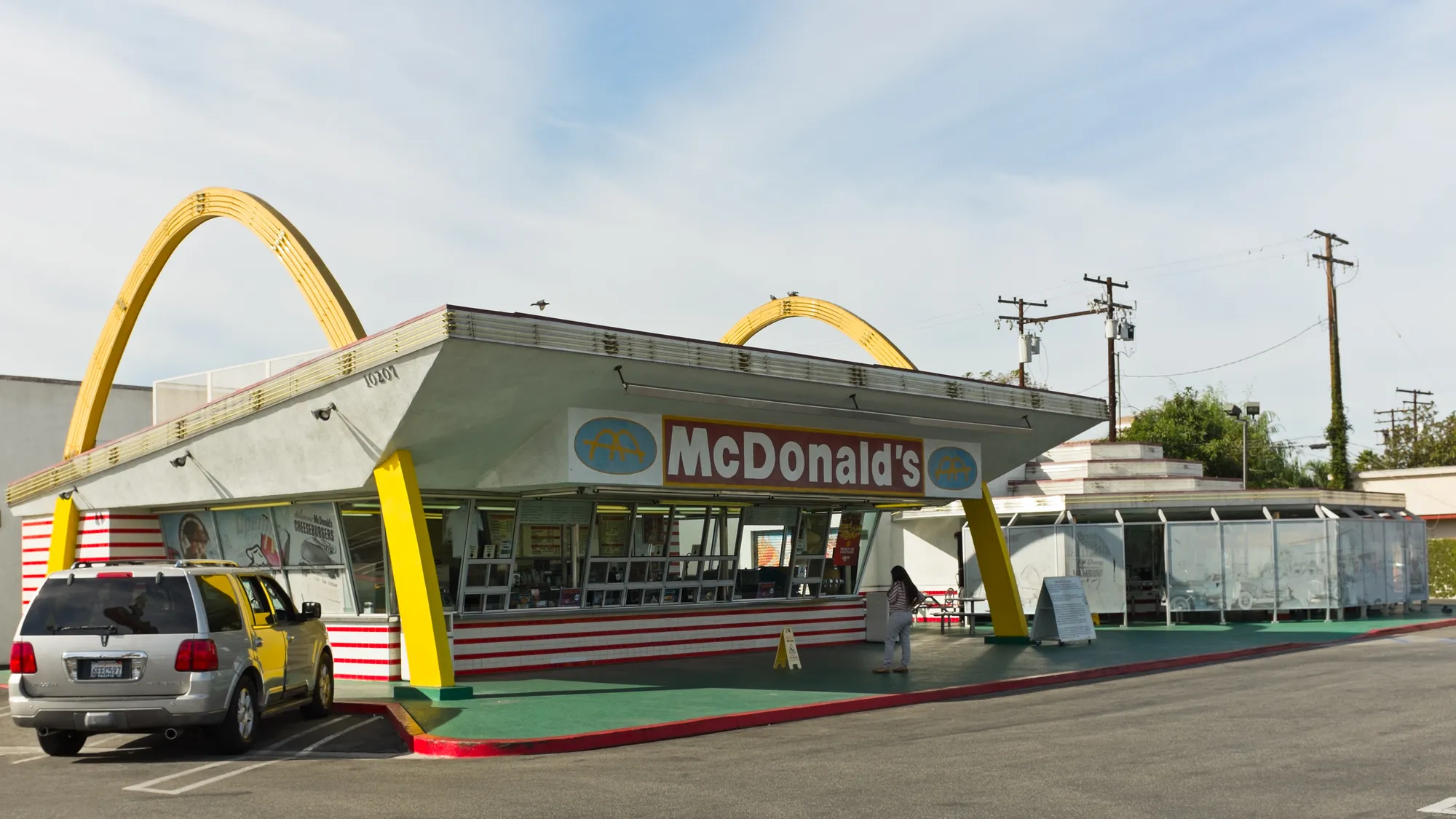
The building won official recognition as a historic resource in 1984, when it was determined eligible for listing in the National Register of Historic Places. It was then 31 years old.
In January 1994 the corporation closed the Downey restaurant, citing damage from the Northridge Earthquake. The Downey City Council stopped the corporation’s attempt to demolish the site. In May 1994 the National Trust for Historic Preservation named the drive-in one of America’s 11 Most Endangered Historic Places. In October 1996 the company announced it would re-open the restaurant, and the restored building re-opened that December.
The coffee shop that gave the style its name could not be saved. These others were kept because someone nominated them, restored them or refused to let them go.
Sources
- House & Home, February 1952 (full issue, includes “Googie Architecture”) (opens in a new tab), House & Home, via usmodernist.org
- Googie Architecture (SAH Archipedia thematic essay) (opens in a new tab), SAH Archipedia, Society of Architectural Historians
- Armet & Davis (opens in a new tab), Los Angeles Conservancy
- Norms La Cienega Coffee Shop (opens in a new tab), Los Angeles Conservancy
- Johnie’s Coffee Shop (opens in a new tab), Los Angeles Conservancy
- Pann’s Coffee Shop (opens in a new tab), Los Angeles Conservancy
- McDonald’s Hamburgers (Downey) (opens in a new tab), Los Angeles Conservancy