California living5 min read
Albert Frey in Palm Springs: The Architect Who Built Around a Boulder
Albert Frey left Le Corbusier’s Paris studio for New York, then Palm Springs, where he built City Hall, a gas station and a hillside house around a boulder.
Albert Frey was born in Zurich in 1903 and died in Palm Springs in 1998, at 95. The Palm Springs Art Museum says he lived and worked there from 1934.
Over a long career he produced more than 200 building designs, among them Palm Springs City Hall and the Aerial Tramway Valley Station, both with John Porter Clark. The Palm Springs Art Museum calls him “the first architect to design a modern International Style structure for Palm Springs.”
This is how a young Swiss architect who had worked in Le Corbusier’s studio ended up building a steel-and-glass house around a boulder on a hillside above the town.
From Zurich to Le Corbusier’s studio
Frey trained in architecture before moving to Paris, where he worked in Le Corbusier’s studio. Visit Palm Springs says the experience exposed him to ideas about form, efficiency and industrial materials. According to usmodernist, he worked on the Villa Savoye project among others.
In 1928 Frey came to the United States. According to usmodernist, Le Corbusier helped him get a job with the architect A. Lawrence Kocher, who was also the managing editor of Architectural Record. Visit Palm Springs says Frey arrived in New York and joined Kocher there.
The Aluminaire House
Visit Palm Springs calls the Aluminaire House the most significant early collaboration between Frey and Kocher. The Palm Springs Preservation Foundation says the Aluminaire House was designed as a case study by Kocher and Frey in April 1931. The three-story house was made of donated materials and built in ten days. The foundation describes it as the first all-metal house in the United States.
It stood in the Grand Central Palace in New York as part of an architecture and allied arts exhibition. According to usmodernist, the show opened on April 18, 1931 for one week and that over 100,000 people toured. A year later the house was included in the Museum of Modern Art’s “Modern Architecture; an international exhibition.”
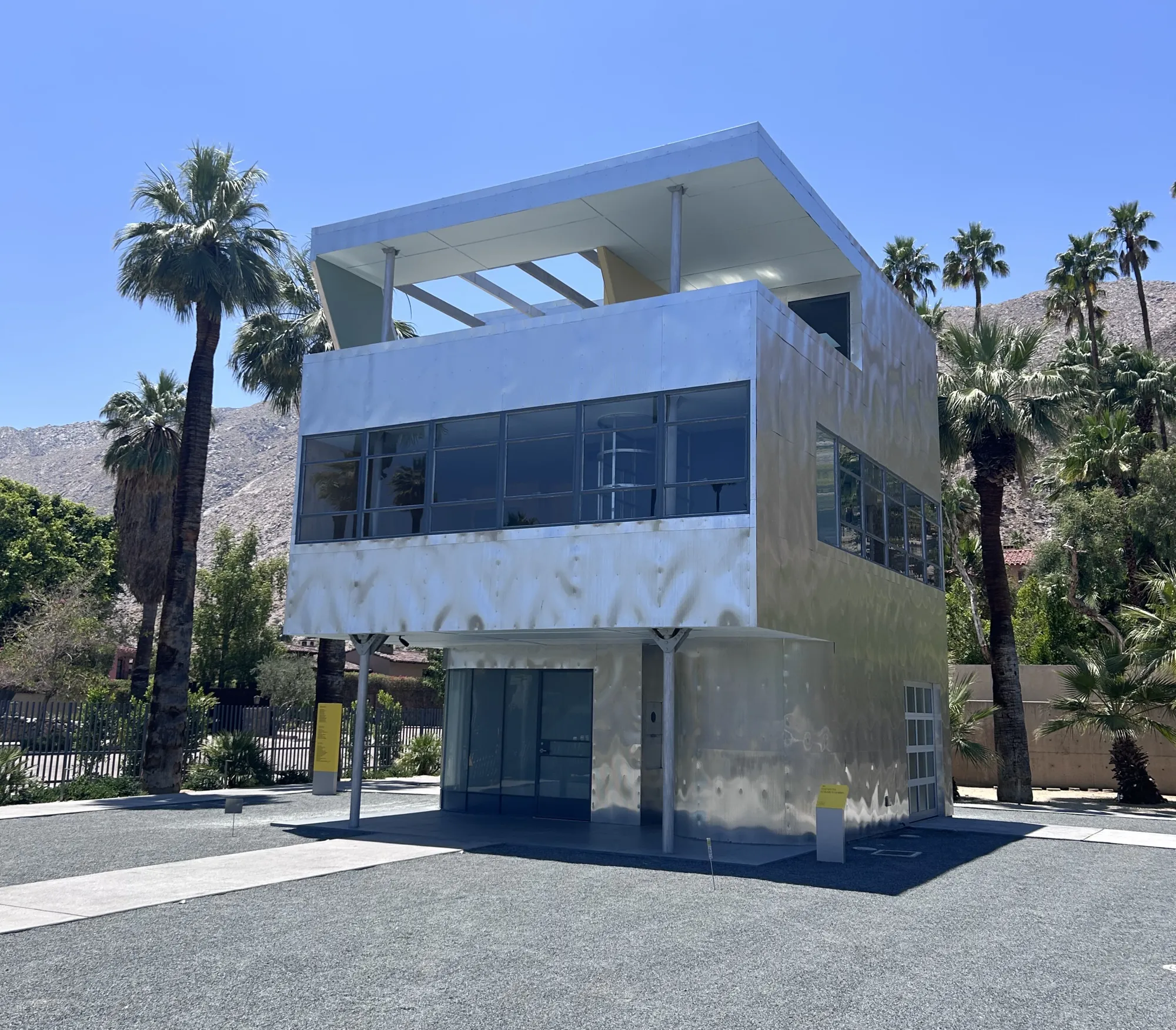
The house then traveled. It was sold to the architect Wallace K. Harrison, who moved it to Huntington, New York, as a guest house. After it escaped demolition by a new owner in 1986, it was moved to the New York Institute of Technology.
Its last move was west. The Aluminaire House arrived in Palm Springs, unassembled, in February 2017, and on March 23, 2024 the Palm Springs Art Museum celebrated the opening of its Aluminaire House exhibit.
A commission that kept him in the desert
The desert came by way of Kocher’s family. A commission in the summer of 1934, an office and apartment building on Palm Canyon Drive for Dr. J. J. Kocher, brought Frey to Palm Springs for the first time. usmodernist notes that Dr. Kocher was the architect’s brother.
The project introduced him to the California desert, and he stayed. In a 1935 letter to Le Corbusier, quoted by the Palm Springs Art Museum, Frey wrote that “the sun, the pure air and the simple forms of the desert create perfect conditions for architecture.” Frey House I dates from 1940; Visit Palm Springs lists it as demolished.
Frey House II and its boulder
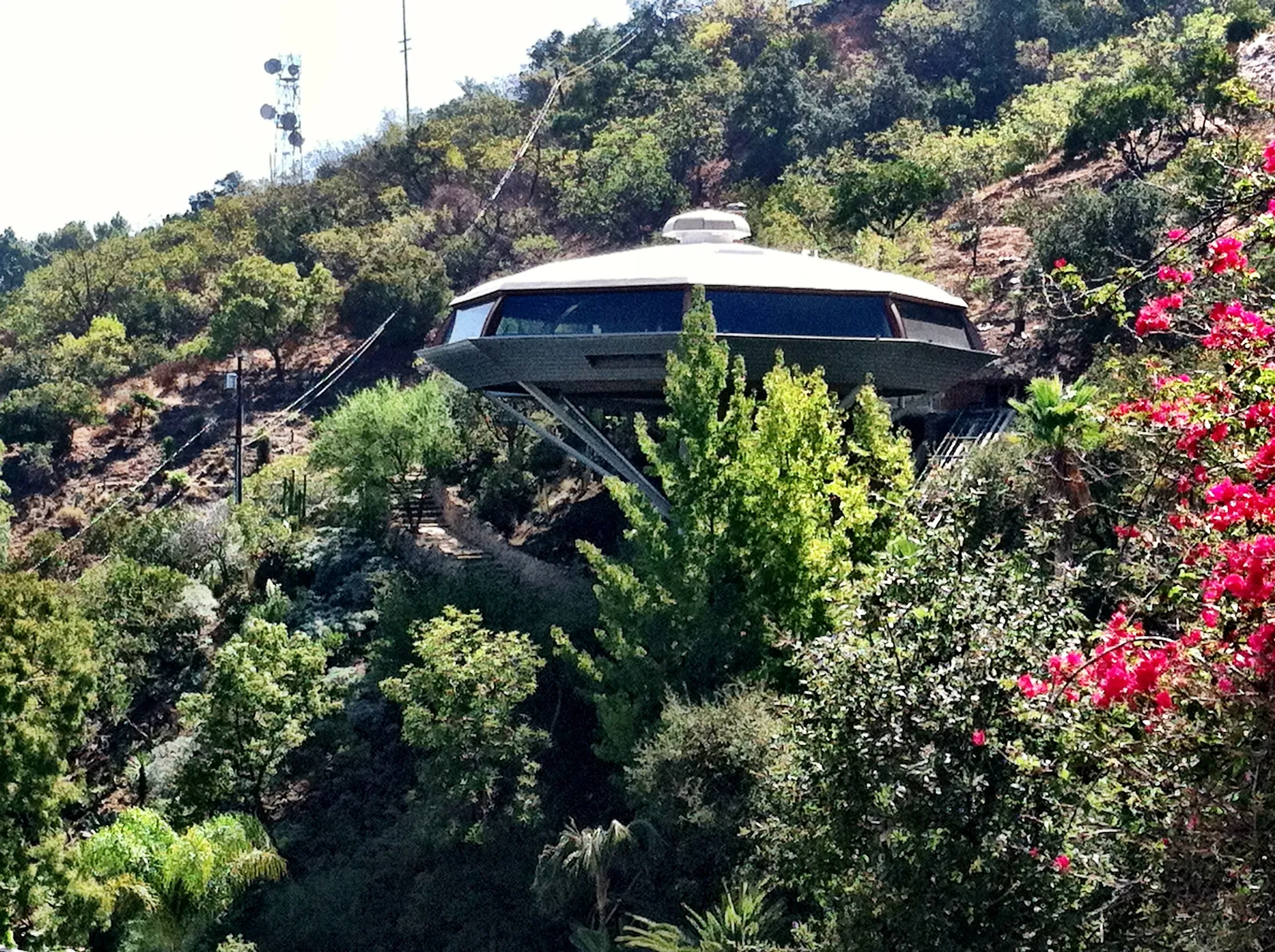
Frey House II was completed in 1964 and, when it was built, stood at the highest elevation of any residence in the city. The museum says Frey took five years to select the site and a year to measure the movement of the sun using a 10-foot pole. C Magazine says Frey spent a year at the site determining the best placement of the house and pool.
Palm Springs City Hall, the museum notes, called the design “crazy” but finally gave its approval. The house measures only 800 square feet, on a concrete block podium that carries a simple steel structure. In 1967 Frey added a guest bedroom of 300 square feet.
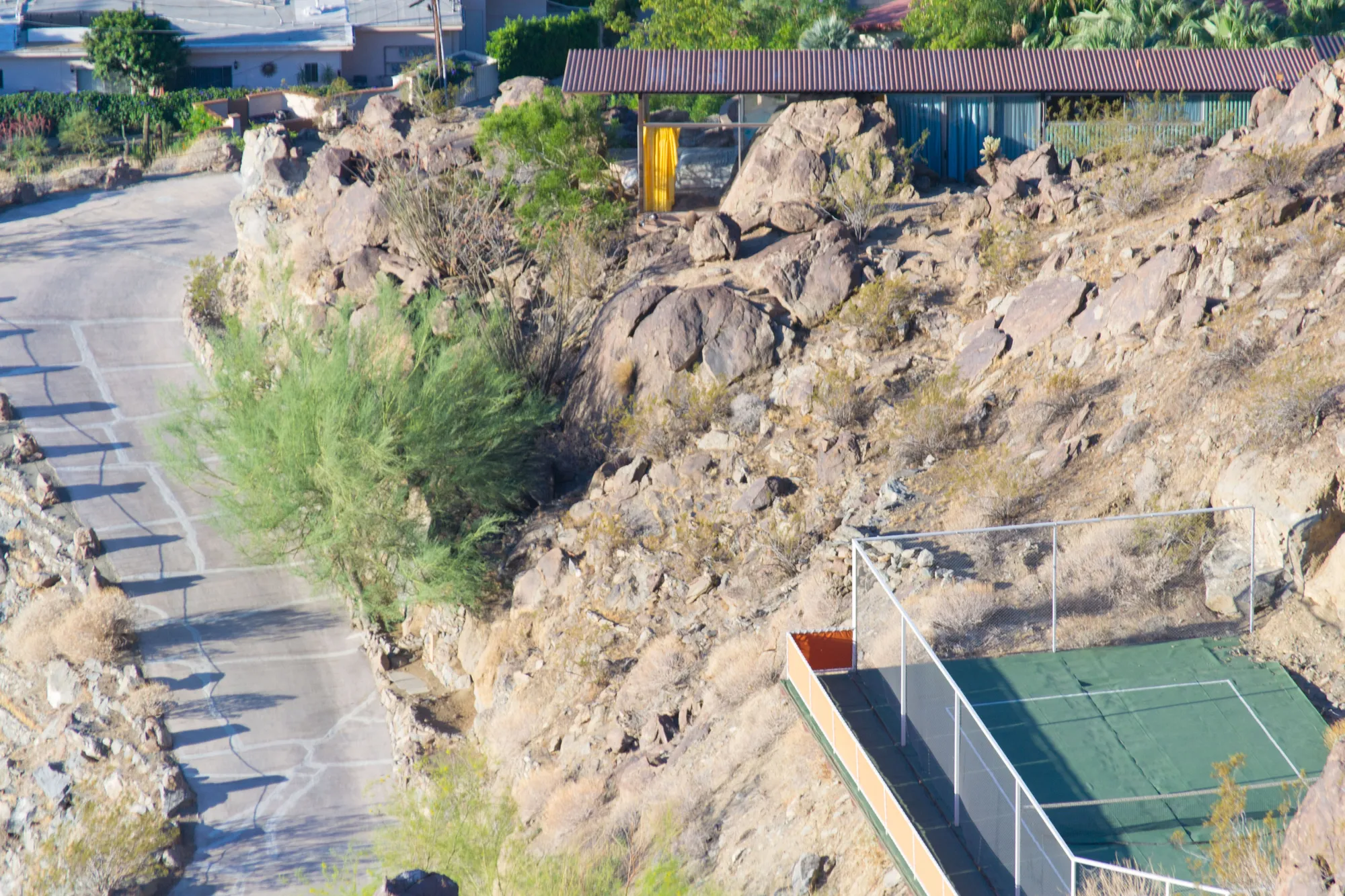
The boulder is what gives the house its character. In the museum’s words, it protrudes into the house and acts as a divider between the bedroom and the living room. C Magazine says the interior spaces fan out from the boulder, separated by low-profile built-ins designed to keep sightlines clear.
Frey explained the idea in a line the museum reproduces: “the contrast between the natural rock and the high tech materials is rather exciting.” He also chose the color of his curtains to match the yellow flowers that bloom each spring in the desert, and painted the ceiling blue.
City Hall and the Tramway Gas Station
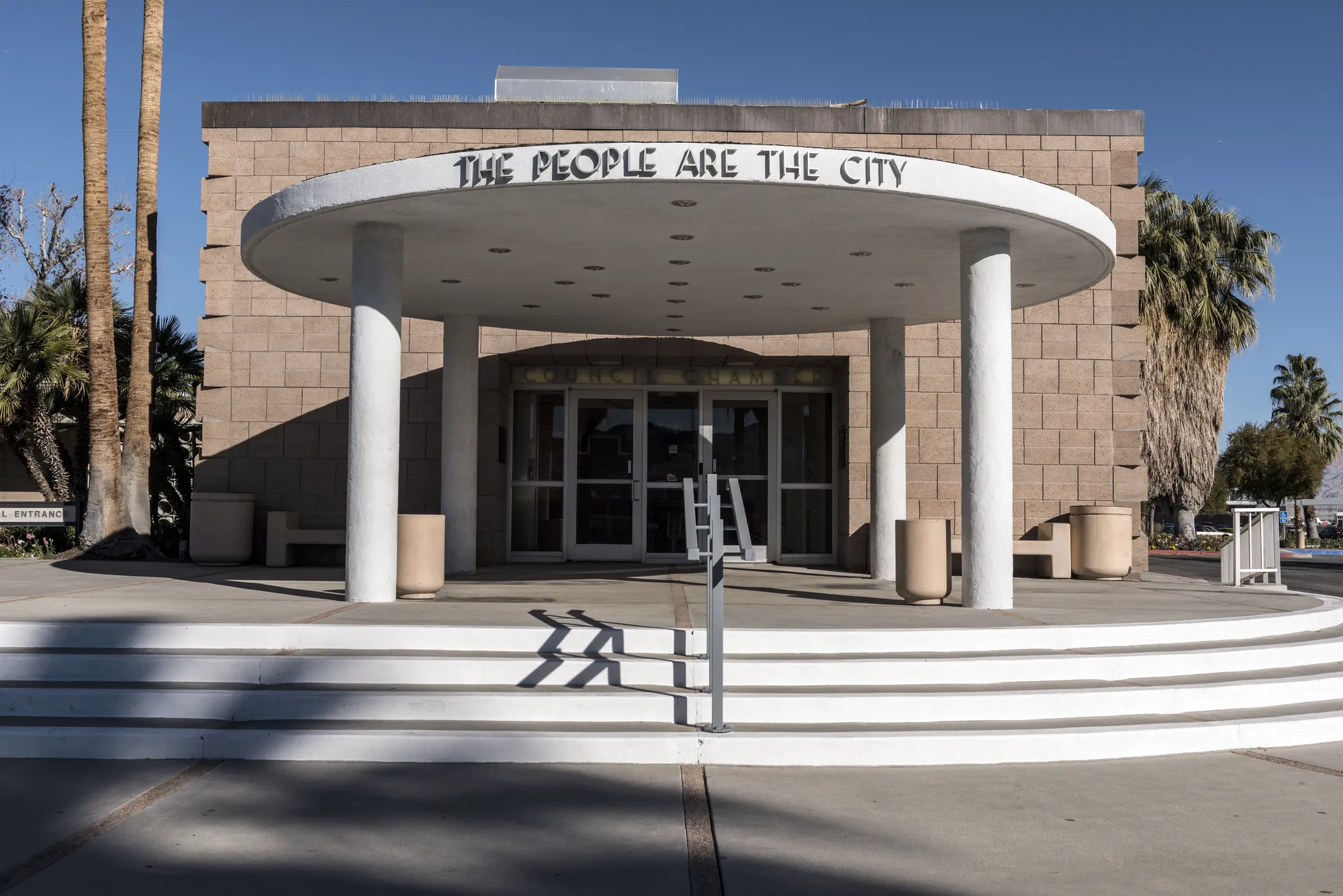
Palm Springs City Hall, which Visit Palm Springs calls one of the most important public buildings by Clark, Frey and Chambers, was a collaboration with the local firm of Williams and Williams. The building’s initial phase was primarily the design work of John Porter Clark and Albert Frey. An unusual detail of the council chamber is its corner treatment: projecting concrete blocks cut diagonally at every other paired row, which allow the blocks to cast light and shadow.
The Tramway Gas Station dates from 1965. A National Register of Historic Places nomination says that since 1965 it has been the first major building a visitor meets when entering Palm Springs from Highway 111. It was designed with Robson Chambers and was first a service station for the Humble Oil Company.
The building is ovoid in plan. A ribbed metal hyperbolic paraboloid roof shelters a structure of sandblasted, terracotta-colored concrete block, and the roof is held aloft by only six steel pipe posts. The nomination adds that Frey did not use that roof form in any other building he designed.
The station was closed for many years. In 1999 it was rehabilitated as a sculpture gallery and, a few years later, became the Palm Springs Visitors Center. After the gas station was finished, Visit Palm Springs says, Frey decided to go solo; from 1966 until his retirement in the 1980s he worked alone.
Frey House II today
Frey died in 1998 and bequeathed the house to the Palm Springs Art Museum. C Magazine says it is one of only two architecturally significant structures in the museum’s permanent collection.
It is not a drop-in visit. The museum says Frey House II is not open to the public for regular visiting hours, though special tours may be available on request or during designated events.
Sources
- Frey House II (opens in a new tab), Palm Springs Art Museum
- Albert Frey: Inventive Modernist (opens in a new tab), Palm Springs Art Museum
- Palm Springs Architect Albert Frey (opens in a new tab), Visit Palm Springs
- California Design Classics: The Frey House II (opens in a new tab), C Magazine
- Albert Frey (opens in a new tab), usmodernist
- Aluminaire House (opens in a new tab), Palm Springs Preservation Foundation
- Tramway Gas Station, National Register of Historic Places registration (opens in a new tab), National Park Service