Provenance5 min read
The Photograph Came First
Julius Shulman’s pictures made Los Angeles houses famous. Restoring one means deciding whether you are restoring the house, the drawings or the picture.
Most people who know the Stahl House have never been inside it. They know a picture.
The picture is by Julius Shulman, made in 1960: two women sit in the corner of a glass-walled living room, looking out over the evening lights of the city. The house, Case Study House #22, was designed by Pierre Koenig, and the Los Angeles Conservancy says it was immortalized by Shulman. For many viewers the house and the photograph are the same thing.
That fusion is the quiet problem of Mid-Century Modern restoration. The photograph came first. The house is asked to match it.
The man with the camera
Shulman was born in Brooklyn in 1910, moved to Los Angeles as a boy and died in 2009, at 98. In 1936 he photographed Richard Neutra’s Kun House, and the pictures led to commissions from Neutra.
The archive he left shows how much he shot. The Getty Research Institute holds more than 260,000 of his negatives, prints, transparencies and related materials, acquired in 2004 from Shulman and his daughter Judy McKee. The finding aid describes him as one of few architectural photographers to use infrared film. It is a record of a profession, not a gallery.
A house in a frame
Photography selects. It frames a plane, drops the neighbor, waits for the light. Shulman’s pictures also included people, furniture and landscape, and they presented houses as places in which a certain kind of life would happen. In the Stahl House picture, two well-dressed women sit in what looks like casual conversation.
The Stahl House shows how far the effect reaches. It sits on Woods Drive, above Los Angeles. It is a Los Angeles Historic-Cultural Monument and is listed on the National Register of Historic Places. A house with that many reproductions of itself in circulation no longer gets approached as a blank slate.
Selling the picture
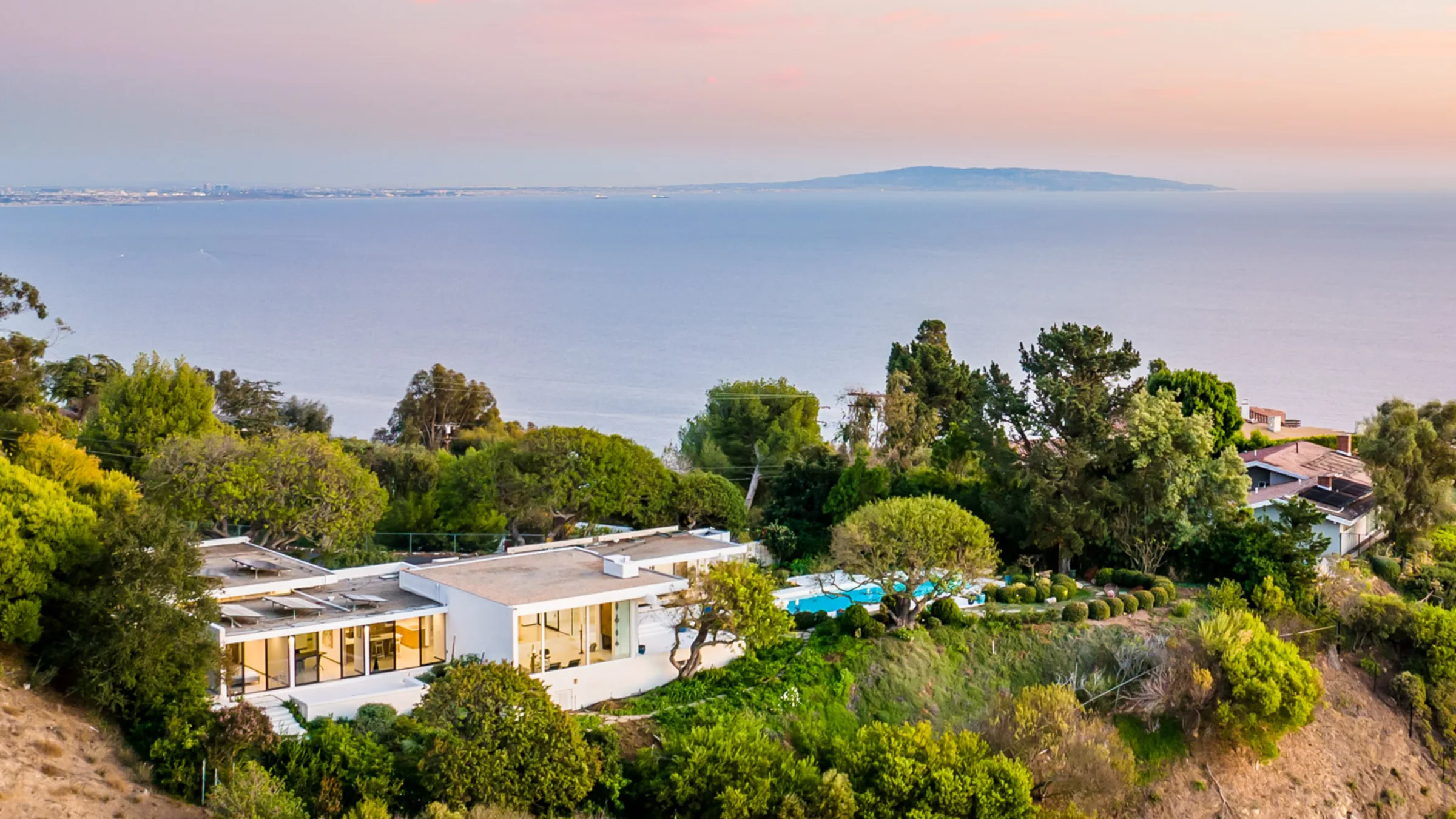
When a house like this comes to market, the buyer is often shopping for a photograph. The roofline is flat, the glass runs to the floor, the pool sits against the horizon: a checklist drawn from the visual vocabulary Shulman and his contemporaries made familiar. The listing photographs repeat the dusk shot because the dusk shot works.
This is not a complaint. Good photographs earn their reputation. But a picture records one moment on one day from one position, and a house is lived in for decades. The picture shows the house at its most composed. It does not show the later kitchen, the carport turned into a room, or the sun screen a later owner added against the afternoon heat. Every house that has changed hands has some of these.
Restoring to the picture, or to the house
Here the tension sharpens. A restoration team can aim at three different targets: the architect’s drawings, the photograph that made the house famous, or the way the house was actually used by the people who owned it. They are rarely the same.
The photograph is the easiest to follow and the least reliable. It shows what one photographer wanted a magazine reader to see. A house restored to a photograph can end up more tidy than it ever was, with furniture arrangements and landscape that belonged to a shoot, not to a household. A house restored to how it was lived in can look less like its own legend and more like a home.
The argument for the drawings is that they show what the architect intended and what the structure was built to do. The argument for the photograph is that it fixed the house in the public mind. The argument for lived history is that a house is a record of its owners, too. None of these is wrong.
Even Shulman’s own home shows the distinction. The house and studio he lived in was designed by Raphael Soriano and completed in 1950, and it became a Los Angeles Historic-Cultural Monument in 1987. Lorcan O’Herlihy Architects later restored it. They restored the corrugated-steel siding and refurbished the original aluminum window and sliding door frames, while updating the kitchen and bathrooms.
How one studio reads a house
Philippe Naouri Studio works from the premise that the house comes before the picture. Its own description of method says it starts “before style: site, proportion, approach, light, circulation, structure and what the property is capable of becoming,” and that the first question “is not what we can add. It is what is already right here.”
Casa Kuderna, in Los Angeles, shows what that looks like. Craig Ellwood, with James Tyler, built the steel-and-glass house at 2977 Passmore Drive in 1956 for the corporate illustrator Charles Kuderna. By 2018 later overhangs and sun screens had been added to Ellwood’s frame. Philippe Naouri bought the house that year and restored it from the archives of James Tyler, with the archivist Barton Jahncke. The additions came off. The yellow exterior spiral stairs, the windows and the woodwork were restored. The floor-to-ceiling jalousie windows, the brick-and-steel fireplace and the walls of glass, all original, stayed.
The studio then closes its projects with a record. At completion, the project is organized into one permanent record of the residence: drawings, materials, suppliers, important pieces, provenance, warranties and project records. In the studio’s words, it is “a house with a record.” Photography is part of that file as project photography, one of six items in the House Archive, next to final drawings and maintenance references. The picture is a record, not the brief.
What the lens leaves out
Shulman’s work stays valuable because it was made carefully, and because it survives. The Getty holds it.
The lesson for owners is practical. Use the photograph to understand the house’s ambition. Use the drawings to understand the structure. Use the owners’ own history to understand how it was used. When these disagree, say which one you are choosing, and why. A restored house that cannot explain its choices has only traded one picture for another.
Sources
- Julius Shulman obituary (NYT, reposted) (opens in a new tab), Docomomo US
- Julius Shulman photography archive finding aid (opens in a new tab), Online Archive of California / Getty Research Institute
- Julius Shulman FAQ (opens in a new tab), Getty Research Institute
- Case Study House No. 22 (opens in a new tab), Docomomo US
- Stahl House (opens in a new tab), Los Angeles Conservancy
- Shulman Home and Studio (opens in a new tab), Architectural Record
- Kun House (opens in a new tab), Neutra Institute