Material intelligence6 min read
Breeze Block Screen Walls: From a New Delhi Embassy to Palm Springs
Decorative concrete screen block shades, vents and patterns a wall. This is how Edward Durell Stone’s embassy grille turned into a Sun Belt standard.
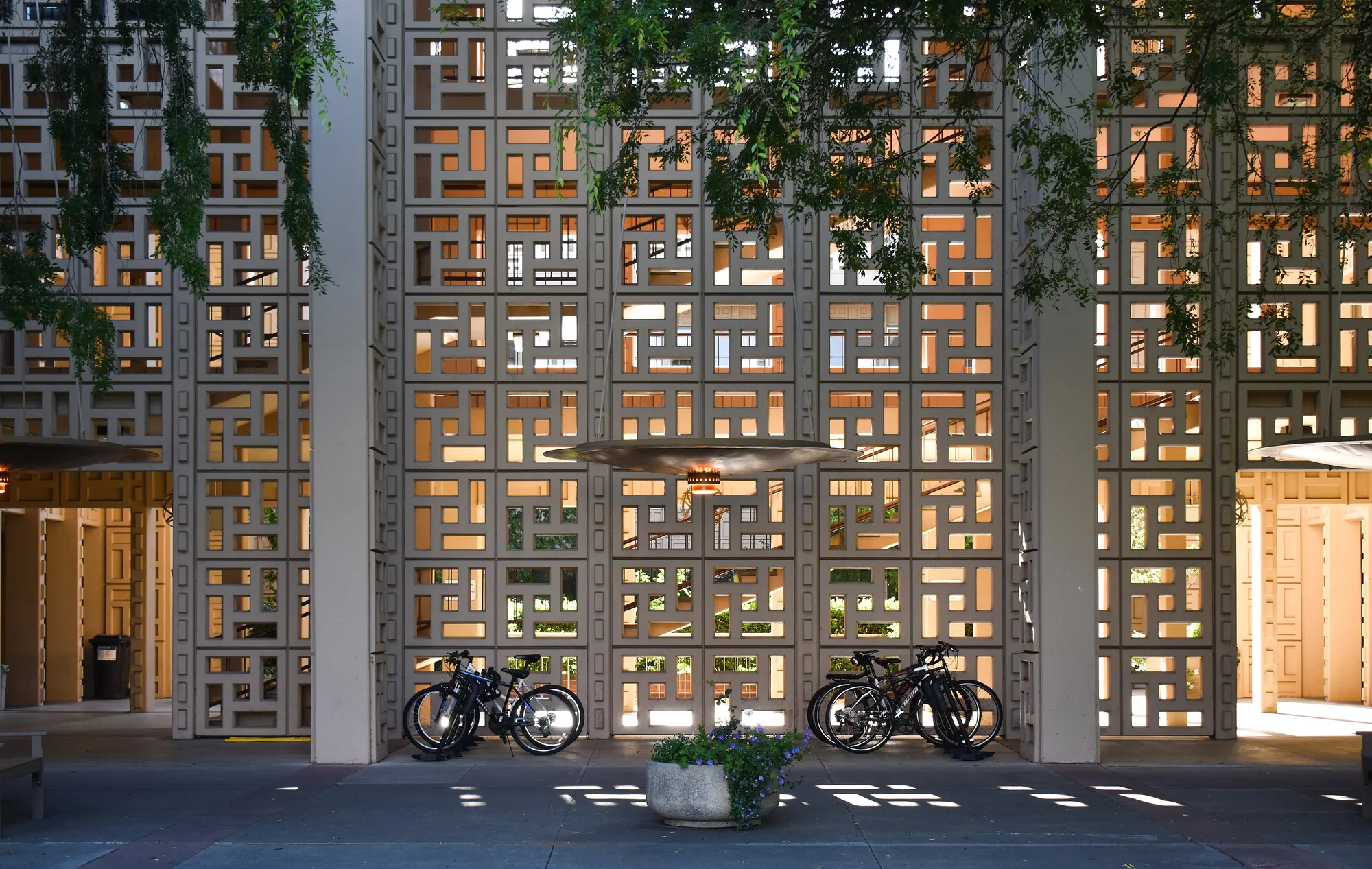
Stand in front of a wall of pierced concrete and the pattern is the first thing you notice. Then the light arrives: it comes through the openings, crosses the floor and moves as the day goes on.
The decorative concrete block has several names. The Society for Commercial Archeology notes that “breeze block” is the Australian terminology for concrete screen block. The Eichler Network, writing about American examples, calls it screen block, and its cousin with projecting faces shadow block. This is where it came from, how it works, and why it spread.
Two ancestors and a missing supplier
The Eichler Network, writing about the history of decorative block, says the story “begins, as so many mid-century modern stories do, with Frank Lloyd Wright.” It points to his “textile block” houses of the 1920s, including the Hollyhock House in Los Angeles, which used “decoratively patterned, deeply textured blocks designed by Wright.”
It adds that Wright’s son, Lloyd Wright, “was probably the first to bring decorative block to Palm Springs” with his Oasis Hotel in 1924. The word “probably” is the magazine’s, and it is worth keeping.
Then not much happened for about thirty years. According to the same article, decorative block “didn’t take off” because the blocks were not commercially available, and “cinder blocks,” as they were called, were considered fit for little more than foundations and industrial buildings.
By the start of the 1950s that was changing. The article cites aggressive marketing by the block industry and the postwar migration of people to the Sun Belt. In January 1953 the Wall Street Journal reported that “The concrete block is getting to be a big boy in the world of building.” At its convention the National Concrete Masonry Association cited a 75 percent jump in block production since the end of World War II.
Edward Durell Stone and the embassy in New Delhi
The Eichler Network dates the turning point to 1953, when Edward Durell Stone began designing a new U.S. Embassy in India. The building, it says, “would be faced in screen block of Stone’s design.”
Docomomo US, which lists the embassy on its register, describes the State Department commission as dating from the early 1950s. Construction began on September 1, 1956, when Chief Justice Earl Warren laid the corner stone. The building was formally opened on January 5, 1959.
The sources do not agree on the date. The Society for Commercial Archeology and the Eichler Network both place the opening in 1958. We follow Docomomo US, which gives specific days for the laying of the cornerstone and the formal opening.
The grille was made by hand. Docomomo US records that “the grillwork was cast in foot-square molds of concrete and marble aggregate, then finished and polished by hand.” The builders moved to the site with their families, and at one time as many as 1800 Indians lived there.
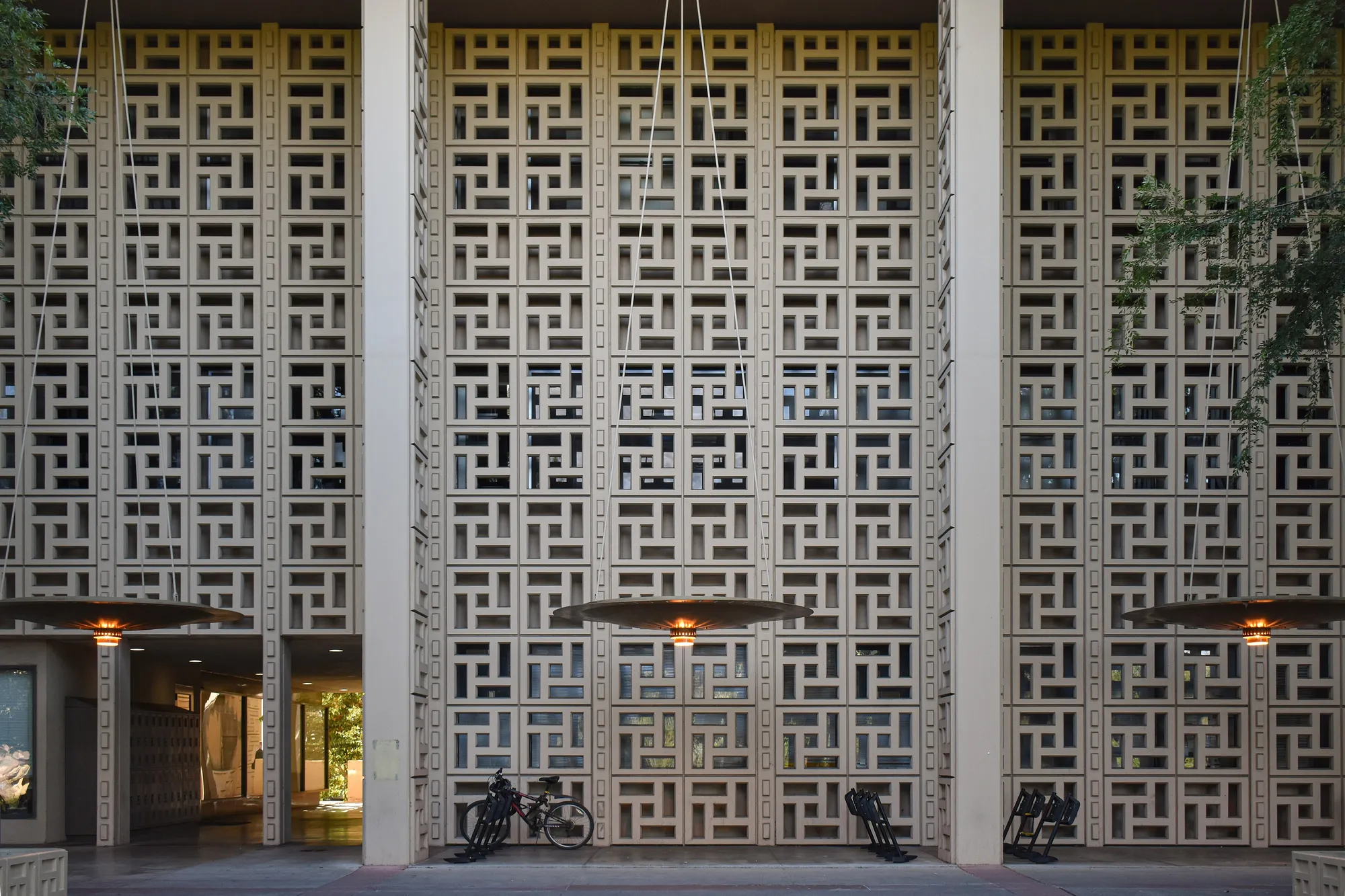
Stone patented a design for the block. Google Patents lists Design Patent 184,463, titled “Wall block,” with Edward D. Stone of New York as inventor, applied for on September 18, 1957 and issued February 17, 1959. The Eichler Network adds that he “never sued to stop others from using” his patterns.
How a screen wall shades and breathes
The idea was not new. The Eichler Network observes that “the idea of screened walls letting airflow and light into courtyards or interiors was not a new one—especially in tropical or desert climes.” It also quotes Stephen White on the American architect Joseph Allen Stein, who moved to India in 1955 and clad buildings in concrete and metal screens that evoked the traditional Indian jali, a latticed screen.
White’s phrase for the effect was “luminous shade, filtered light, and a sense of enclosure without total separation from the outdoor spaces.”
At the embassy the screen had a job to do. Docomomo US describes the exterior glass curtain wall as protected by “a vivid and climatically responsive sunscreen.” Overhanging canopies were separated from the second-floor ceiling by a gap that “served as a breezeway to reduce air conditioning loads,” and “pierced screens were used to dissipate penetration of sunlight and reduce glare.”
The light changes the wall as the day goes on. The Eichler Network notes that light hitting the blocks adds shadows on the exterior and patterns of light in the openings, and that some blocks change color at sunset and dawn, or in the light of the moon.
Many patterns also cannot be read from a single block. They appear only when blocks are set together in a wall.
From one embassy to the Sun Belt
The embassy got a lot of press. Ron Marshall, who wrote the book Concrete Screen Block with his wife, Barbara, told the Eichler Network that “It really exploded into the popular culture when the New Delhi embassy got a lot of press.” He dates the wide popularity of screen block to 1957, though the article notes that the blocks had begun appearing two years earlier.
Stone later reflected on what followed. The Eichler Network quotes him: “It was inevitable,” he wrote, “that such a simple, inexpensive, and practical device would immediately become part of the building vocabulary and would have wide and indiscriminate usage.”
Industry figures bear that out. In 1959, Business Week reported that thanks to automation and faster curing of concrete, manufacturers were churning out more than 300 varieties of decorative block.
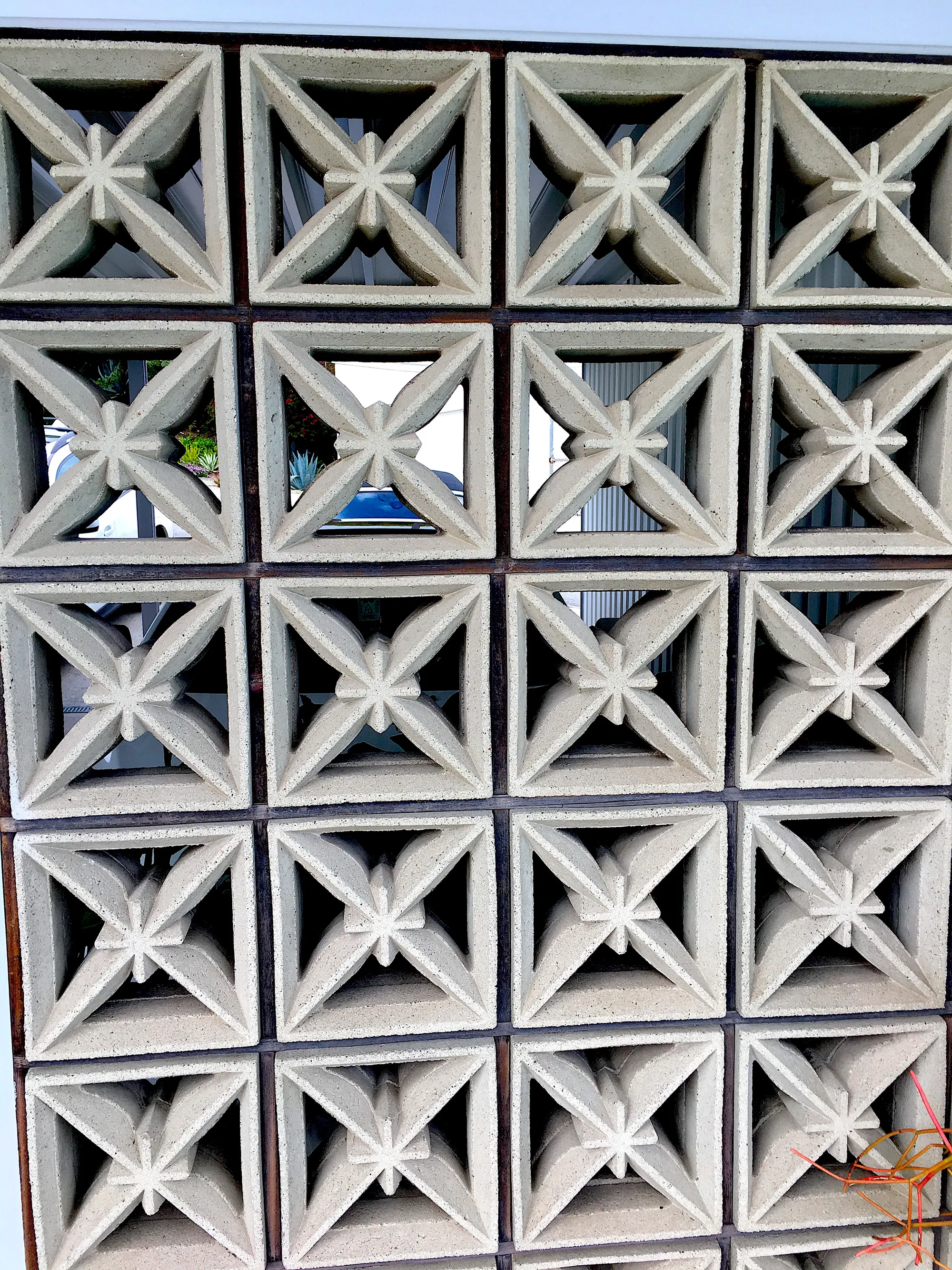
Architects across the country picked it up. The Eichler Network names Gardner Dailey at the University of California, Berkeley, and Minoru Yamasaki, who used screen block on the American Concrete Institute headquarters in Detroit. Stone himself used decorative block on Stanford Medical Center, Palo Alto’s Rinconada Library and the Huntington Hartford Museum in Manhattan.
Palm Springs became the showplace. The article says no California city is better for enjoying decorative block, and credits the architect Bill Krisel, who with partner Dan Palmer filled neighborhood after neighborhood there with screen block walls. Krisel called the blocks “functional ornamentation.”
He also explained how the patterns got made. “We did such a volume that we could design our own building material,” Krisel said in a 2012 interview. “All the shadow block, pierced [screen] block, we designed those and had the concrete block people make them.”
Out of fashion, and back again
By the start of the 1970s the fashion had turned. The Eichler Network quotes Anthony Rubano of the Illinois Historic Preservation Agency, who wrote that the block’s “resulting prevalence signaled its demise as a high-style motif.”
The Marshalls have a second theory. They surmise that better air-conditioning and window film made the cooling effect of screen blocks less popular. In compiling their book, they have catalogued more than 250 screen block patterns, and say they are counting only screen blocks, not shadow or textured blocks.
Today the blocks are sought out again. The Marshalls say they have noticed increasing use around Palm Springs, often added to tract homes of the period. Barbara Marshall adds a caution: “The blocks that are available today are only a couple of patterns, not the more interesting vintage molds.”
Sources
- U.S. Embassy, New Delhi, India (opens in a new tab), Docomomo US
- Blocks of Beauty (opens in a new tab), Eichler Network (Jack Levitan)
- USD184463S - Wall block (opens in a new tab), Google Patents (U.S. Patent Office, Des. 184,463)
- JOURNAL SNEAK PEEK: Mid-Century Modern Blockheads (opens in a new tab), Society for Commercial Archeology